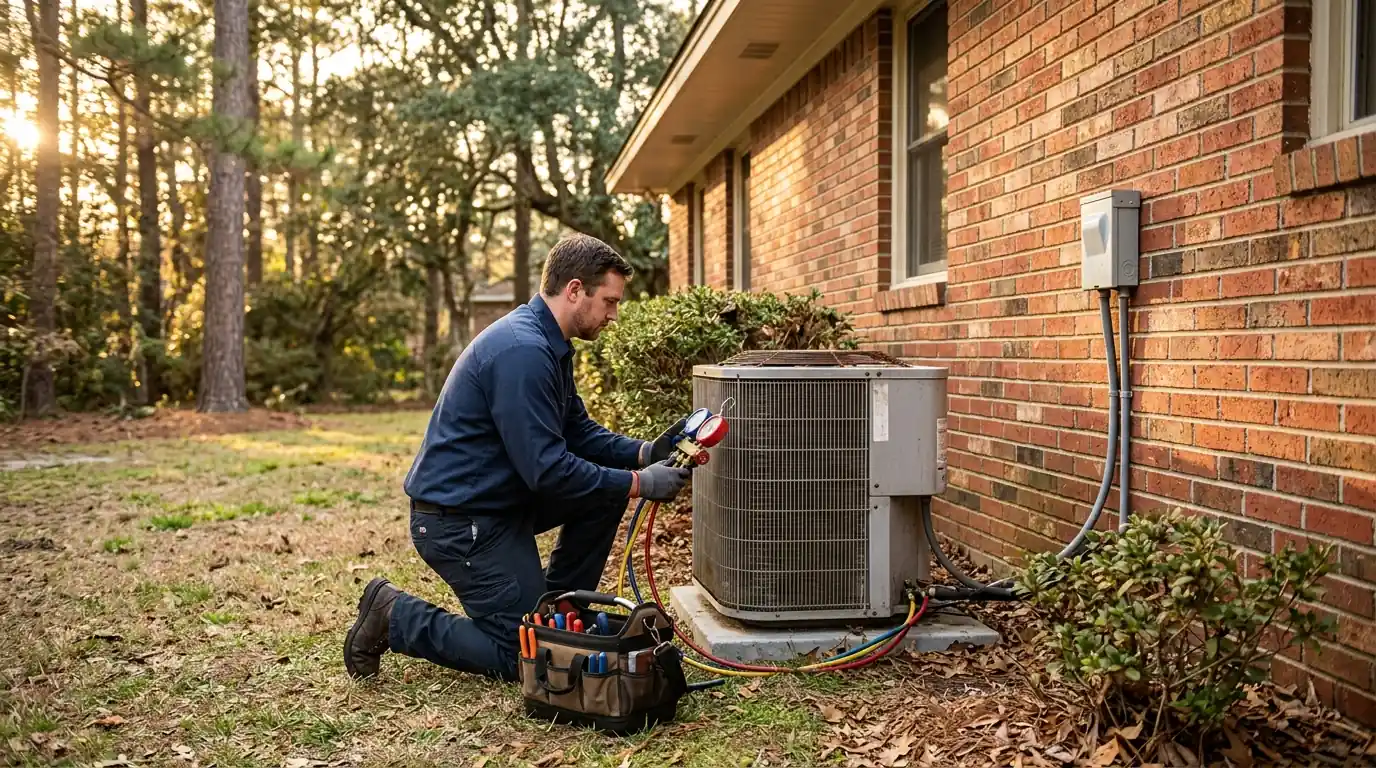
Air handler repair in Atlanta usually comes down to four parts: the blower motor, the heat strip sequencer or relay, the control board, or a cabinet rusted through by condensate. We test each with a meter instead of swapping parts on a guess, and every heat strip element gets an amp draw check.
How we handle air Handler & Heat Strip Repair in Atlanta
An air handler is the indoor half of a heat pump or all-electric system. It holds the blower, the evaporator coil and, in homes without gas, a bank of electric resistance heat strips. It lives in an attic, a hall closet or a garage, and it controls what the outdoor unit can't: airflow, auxiliary heat and drainage.
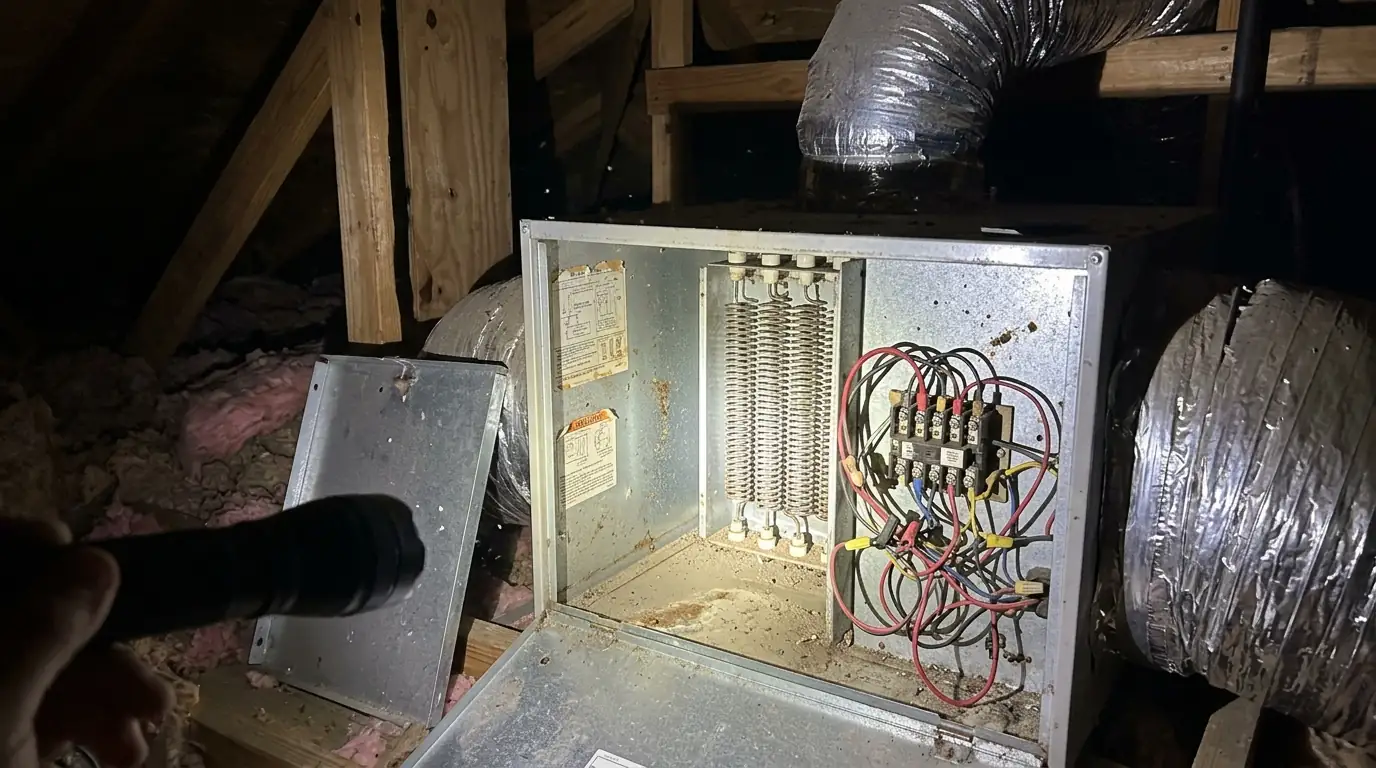
Repairs here overlap with other work. A blower that hums but won't turn may need a new blower motor. Water in the pan points to a clogged drain or float switch. And if the outdoor unit is the reason air runs cold in heat mode, it's a heat pump repair.
Air handler symptoms you can spot from inside
These point to the indoor unit rather than the outdoor side.
Cool air in heat mode on a cold night
Strips may not be engaging when the heat pump falls behind.
Hot-metal smell at the vents
A strip element or wire terminal may be overheating.
Outdoor unit runs, no airflow inside
Blower motor, capacitor, board or a tripped float switch.
Breaker trips when heat comes on
A shorted element or strips staging on all at once.
Ceiling stain below the attic unit
Rusted pan, clogged drain or a cabinet leaking at the seams.
Blower never shuts off
A stuck relay on the board, or the fan set to on.
When the air handler blower will not run
If the thermostat calls and no air moves, we start at power. A tripped breaker, an open door safety switch, or a blown low-voltage fuse on the board stops everything. A float switch tripped by a clogged drain also cuts the blower on many units. If power reaches the motor and it hums without spinning, the run capacitor on a PSC motor or the module on an ECM motor is the usual suspect. We check voltage at each point, so you don't pay for a motor when the real fault was a seized wheel or a pinched wire.
Heat strip sequencer and relay failures
Heat strips are coils of resistance wire that glow hot when the heat pump needs help or during defrost. Sequencers or relays bring each element on in stages so the breaker never sees the full load at once. When a sequencer sticks open, the strips never come on and the house falls behind on cold nights. When it sticks closed, strips keep heating after the blower stops and the high limit trips again and again. We measure amps on each element and check limits and fusible links. Burned terminals at the strip block get replaced, not cleaned.
Control board faults
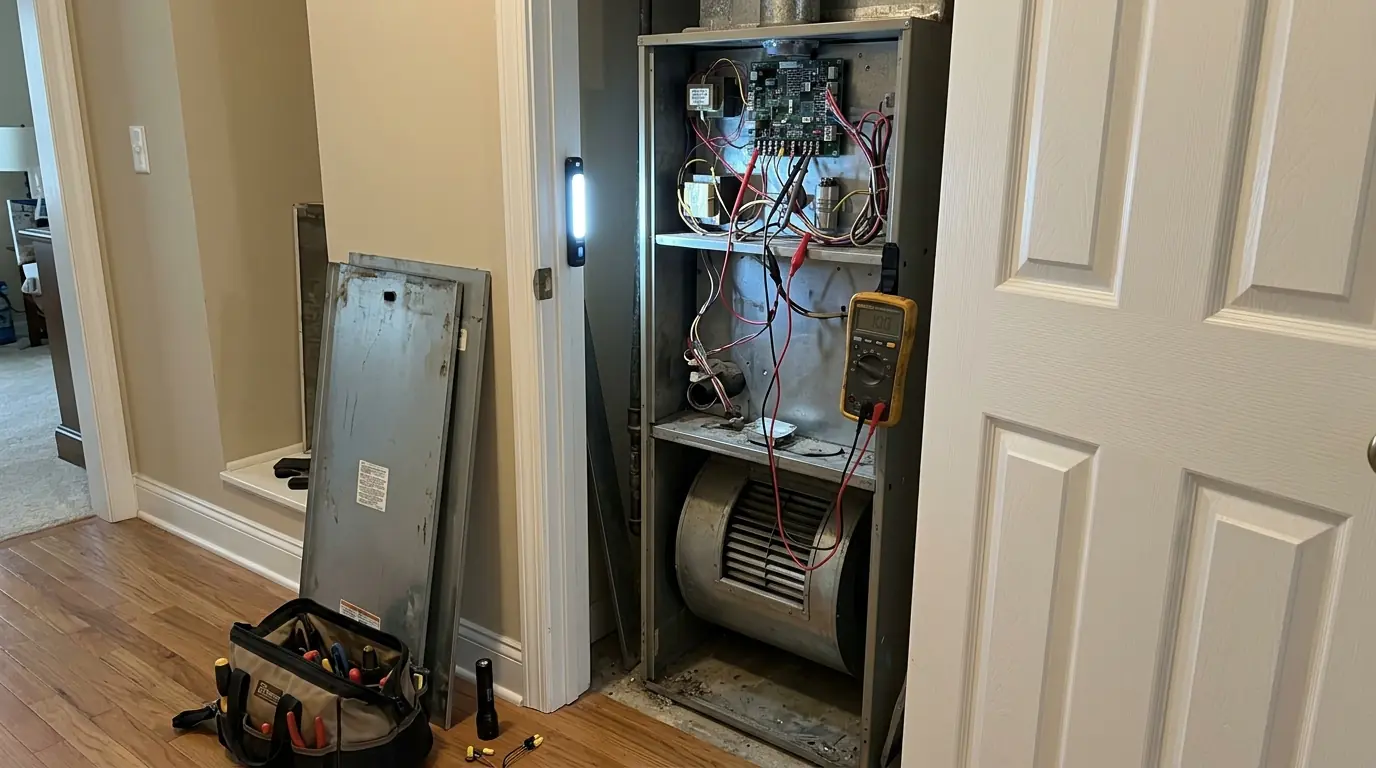
The board takes thermostat signals and decides when the blower runs, at what speed, and when strips come on. Boards fail from power surges, water dripping off a sweating coil, or a shorted thermostat wire that keeps blowing the fuse. Symptoms include a blower that never stops, no response to the thermostat, or a fuse that blows right after replacement. We read the diagnostic light and trace any short before fitting a board matched to the motor and strip kit.
Rusted air handler cabinets and pans
Attic air handlers sit in hot, damp air most of the year, and the coil sheds water all summer. Over time the drain pan corrodes, the cabinet floor rusts and water finds the ceiling below. If the rust is limited to the secondary pan under the unit, we replace that pan and add a float switch. If the cabinet floor and coil pan are gone, patches rarely hold. Then we weigh the age of the coil and blower, and often the honest answer is a new air handler matched to the outdoor unit.
How we diagnose an air handler
Confirm the call
We check that the thermostat signal reaches the board on each wire: fan, cooling, heat pump and auxiliary heat.
Power and safeties
We test line voltage, the door switch, low-voltage fuse and float switch before suspecting bigger parts.
Blower test
We check capacitor value or ECM module response and spin the wheel by hand for bearing drag.
Strip amp draw
With heat called, we read amps on each element and confirm the sequencers stage them in order.
Repair and verify
We replace the failed part, run full heat and cool cycles, and check temperature rise across the strips.
Equipment brands we service and install
Most homes around Atlanta run equipment from a handful of major manufacturers. We diagnose, repair and replace Carrier, Trane, Lennox, Goodman, Rheem and Daikin systems, along with the other names below.
Brand names are shown to describe the equipment we work on. We are not claiming a dealer or factory relationship with any manufacturer.
Atlanta homes, weather and this job
Heat strips are pure resistance heat, and in an all-electric house they show up fast on the power bill. For many metro Atlanta homes that bill comes from Georgia Power, which serves more than 2.8 million customers across nearly every county in the state. When a sequencer sticks closed or the thermostat calls for auxiliary heat too eagerly, strips can run for hours while the heat pump could have carried the load. Part of every air handler repair we do is confirming the strips only come on when they should.
What to check before you call, and what to leave alone
A few checks are safe. Heat strip circuits carry high voltage on large breakers, so the cabinet interior is not a homeowner area.
| Task | What you can do | Where a technician comes in |
|---|---|---|
| Thermostat settings | Confirm mode, setpoint and fan on auto | Trace wiring if the call never reaches the unit |
| Filter | Replace a clogged filter at the unit or return | Measure static pressure if filters load fast |
| Breakers | Reset a tripped breaker once | Find why it tripped before another reset |
| Heat strip cabinet | Leave the panel closed | Amp draw, limit and sequencer tests with power isolated |
Planning ranges for air handler repairs
No single published range covers every air handler fault. The closest figures are general repair visits and blower motor replacement, the priciest common part.
| Job | Published planning range | Source |
|---|---|---|
| Typical AC repair visit | $150 to $650 | How Much Does AC Repair Cost? (2026) - HomeGuide |
| Blower motor replacement | $500 to $2,300 | How Much Does AC Repair Cost? (2026) - HomeGuide |
What moves the number
- Failed part: sequencer, relay, board or motor
- PSC or ECM blower motor
- Attic, closet or garage access
- Strip kit size and element count
- Cabinet or pan corrosion
These are ranges published by the sources linked above, shown for planning. They are not a quote and not our price; the real number depends on what we find at your home.
Air Handler & Heat Strip Repair questions from Atlanta homeowners
In deep cold a heat pump's output drops, and the strips in the air handler are supposed to fill the gap. If a sequencer or element has failed, you lose that help. It can also be the heat pump in defrost without strips tempering the air. We test both.
Turn the heat off. A brief dusty smell the first time strips run each fall is normal. A lingering hot-plastic smell can mean a melted terminal. We answer 24/7 and can often isolate the strips so the heat pump keeps running.
If the rust is in the secondary pan under the unit, yes, it's a separate part. If the coil's own pan or the cabinet floor is rusted through, repairs rarely last, because the coil sits right in it. We show you which one it is before recommending anything.
Possibly. Aux should come on when the heat pump falls behind, during defrost or after a big setpoint jump. Constant aux in mild weather can mean low charge, an iced coil or a misconfigured thermostat. Our thermostat setup work covers aux heat lockout settings.
That fuse protects the 24-volt control circuit. If it blows repeatedly, a thermostat wire is shorting somewhere, often where it's chewed, stapled or rubbing sheet metal at the outdoor unit. A new fuse without finding the short just burns another one.
Not as a repair, but it can be part of a replacement if an interior closet has room for the unit, a return and a drain. It changes the duct layout, so we plan it alongside duct changes.
Updated October 2026