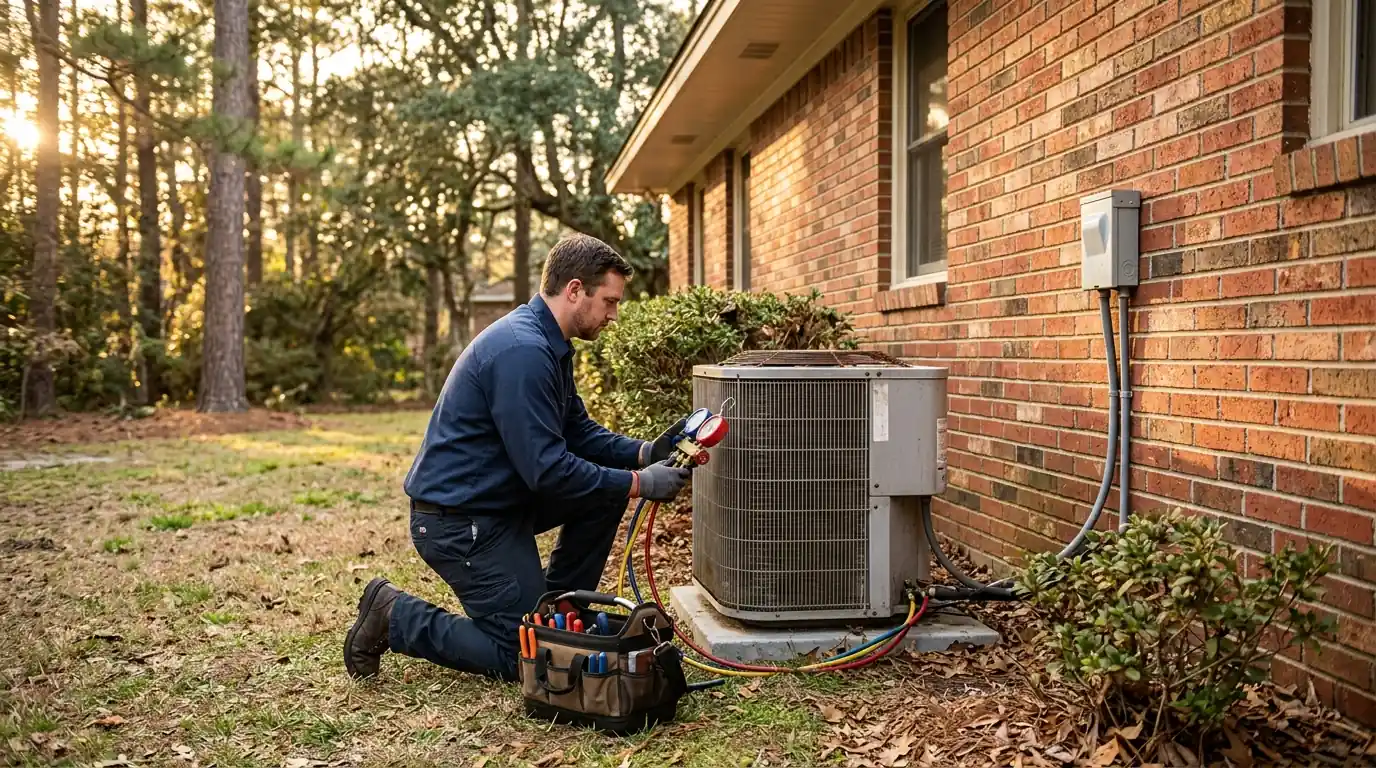
Commercial HVAC repair in Atlanta usually means rooftop package units and split systems serving offices, restaurants and stores, where the failure shows up at peak occupancy. We work around business hours where we can, diagnose at the unit with the economizer, belts and controls in view, and explain repair versus replacement before parts are ordered.
Commercial HVAC Repair: what we check and why it matters
Commercial systems fail differently from house systems. A rooftop unit carries cooling, heating, outdoor air and often an economizer in one cabinet, and it works harder because of people, lighting, cooking and doors opening all day. A single bad belt, a stuck outdoor air damper or a failed control board can take out a whole zone.
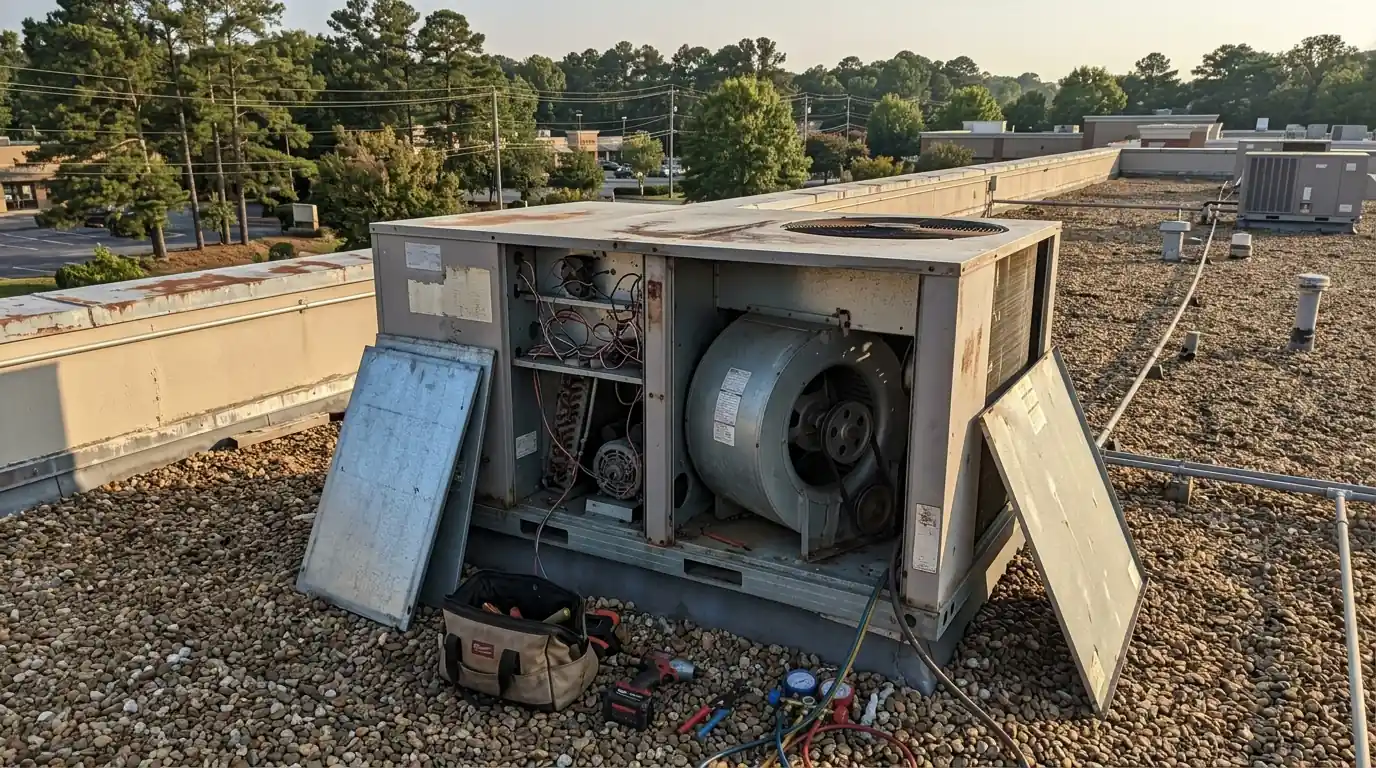
We answer 24/7 and plan repairs around your hours when the failure allows it. On the roof we check the electrical, refrigerant circuit, gas section, belts and economizer together, because a unit that trips on high pressure may have a dirty condenser coil, a dead fan motor and a stuck damper at once. If replacement starts to make more sense, our rooftop unit replacement page covers what that involves.
Signs a commercial unit needs attention now
These usually show up on the floor before anyone climbs to the roof.
One zone warm, others fine
Often a single RTU, belt or zone damper has failed.
Water stains on ceiling tiles
A condensate pump or drain above the grid may be overflowing.
Doors whistling or hard to open
The building may be running negative from exhaust without makeup air.
Squealing from the roof
A slipping or worn blower belt is likely.
Sticky air near entrances
Outdoor air settings or a stuck economizer may be pulling in humidity.
A unit that runs all night
Scheduling, a failed thermostat or a lost program after an outage.
How long a commercial repair usually takes
Most single-component repairs on a rooftop unit, such as a motor, belt, contactor or capacitor, are finished in one visit when the part is common. Control boards, compressors and economizer actuators may need ordering, and in that case we look for a temporary way to keep part of the space conditioned, such as running a second unit harder or getting a stage of cooling back.
Rooftop package units
Common RTU complaints are warm air on the hottest afternoons, a unit that runs but never satisfies, or one that trips its high-pressure switch. The cause is often a condenser coil packed with pollen and debris, a failed condenser fan motor, a worn or slipping blower belt, or an economizer damper stuck open and pulling in humid outdoor air. We test each section, read refrigerant pressures and temperatures against the unit's data, and check the economizer actuator and sensors. Many units come back with a coil cleaning, a motor and a belt; older units with a failed compressor deserve a replacement discussion.
Office split systems
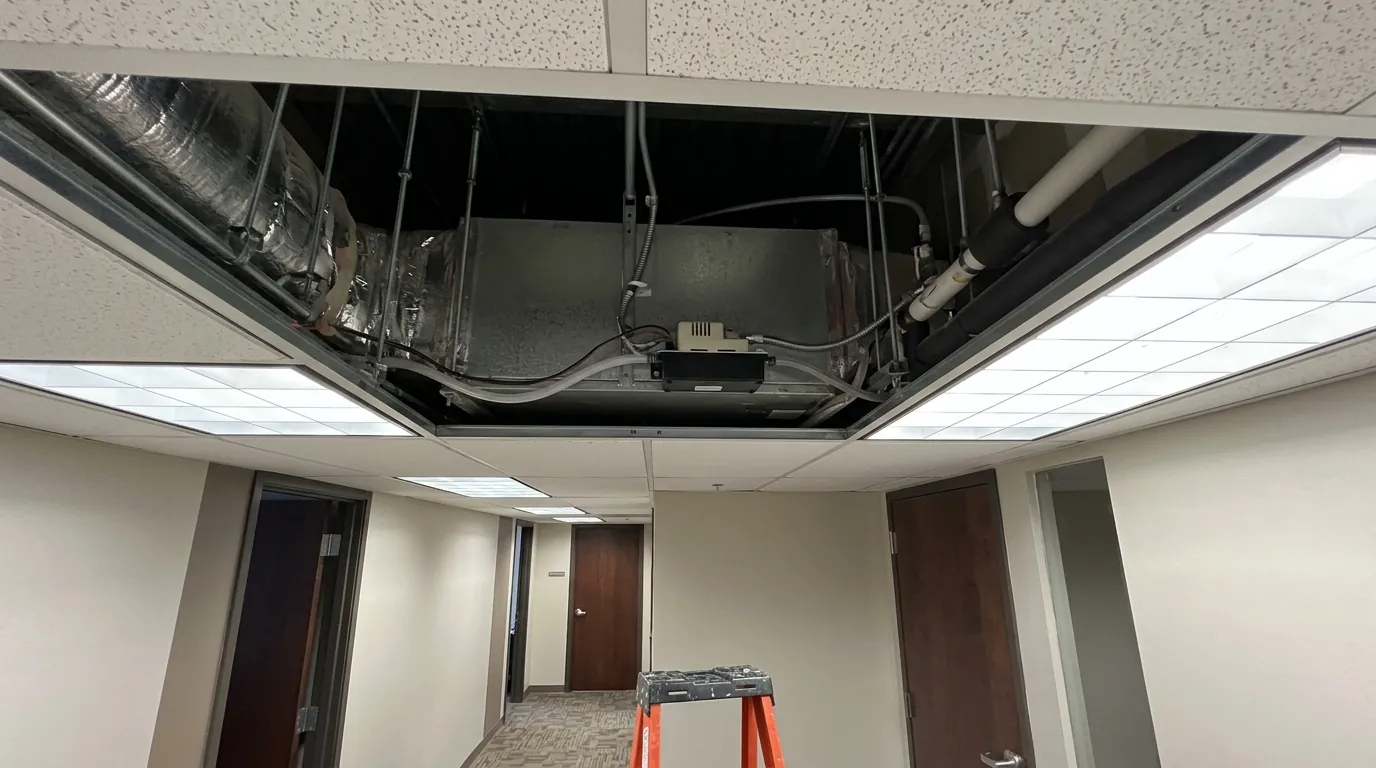
Offices in converted buildings and low-rise suites often run residential-style split systems or larger commercial splits with air handlers above the ceiling grid. Complaints sound familiar: one room freezing while another is stuffy, water stains on ceiling tiles, or a system that runs all night. The fix may be a failed condensate pump above the ceiling, a zone damper motor that quit, or a programmable thermostat lost after a power outage. We check ceiling-space drains first, since a wet tile is the warning sign. See zoning controls for damper work.
Restaurant kitchens
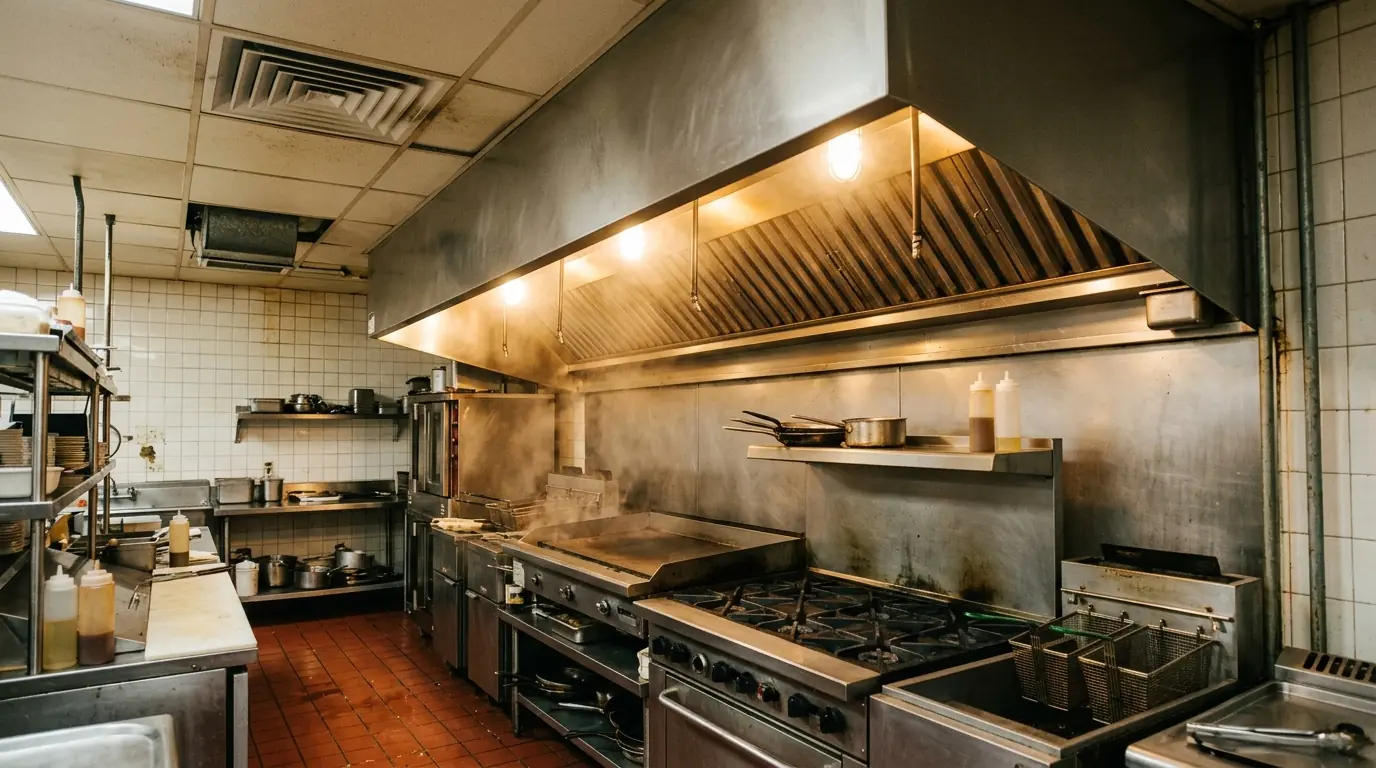
Kitchens run hot by design, but a dining room that warms up as the line fires, or doors that whistle or slam, usually point to a makeup air problem. Exhaust hoods pull large volumes of air out, and if the makeup air unit or the rooftop's outdoor air does not replace it, the building goes negative. The RTU then fights hot, humid air pulled through every gap. Grease-laden air also coats condenser and evaporator coils faster than in offices. We check makeup air operation, hood balance against supply and coil condition, and fix the piece that is actually out of step.
Retail storefronts
Storefronts deal with constant door traffic, street-facing glass and lighting heat. Complaints include a warm, sticky sales floor near the entrance, condensation on the glass, or a unit that runs continuously yet never catches up on a Saturday. Often the system is fine on paper but the coil, filters or belt are worn, the thermostat sits near a hot display, or the outdoor air setting is too high for the humidity. We check airflow, coil temperatures and control setup before suggesting larger equipment. Our commercial maintenance plans keep coils and belts from getting there.
How a commercial service call runs
Get the history
We ask which zones are affected, when the problem started and what the building schedule looks like.
Check the whole unit
We look at electrical, refrigerant, gas, belts, filters and economizer together rather than stopping at the first fault.
Measure, not guess
We record pressures, temperatures, amperage and airflow, so the diagnosis is backed by readings.
Lay out the options
You get the repair, its effect on the unit's remaining life, and when replacement would make more sense.
Repair and log it
We make the repair, run the unit through cooling, heating and economizer modes, and leave a written record for your files.
Equipment brands we service and install
Most homes around Atlanta run equipment from a handful of major manufacturers. We diagnose, repair and replace Carrier, Trane, Lennox, Goodman, Rheem and Daikin systems, along with the other names below.
Brand names are shown to describe the equipment we work on. We are not claiming a dealer or factory relationship with any manufacturer.
The local side of commercial HVAC Repair
South of the airport, commercial HVAC calls look different from one town to the next. Fayetteville keeps the oldest surviving courthouse in Georgia, built in 1825, and is home to Trilith studios, while Douglasville's downtown is a National Register district of Romanesque, Italianate and Queen Anne buildings. Historic masonry storefronts usually carry split systems squeezed into tight attics and back rooms, with long refrigerant runs, while large modern production and office space leans on rooftop units. We plan access, parts and timing around which of those we are walking into.
What drives a commercial repair bill
Published ranges for commercial repairs vary too widely to be useful for planning, so we list the factors instead. We explain the cost of the specific repair before starting it.
What moves the number
- Unit tonnage and type
- Roof access, ladders or lifts
- Part availability for the model
- Refrigerant type and amount
- After-hours scheduling to avoid closures
- Economizer or control board involvement
Commercial HVAC Repair questions from Atlanta homeowners
Usually. Most diagnosis and many repairs happen with only that unit offline. If a repair means shutting power to more of the building or bringing a lift into the parking lot, we plan it before opening or after close.
Usually because the kitchen exhaust is pulling more air out than the system brings back in, so hot, humid outdoor air leaks in through doors and gaps. Checking makeup air operation and hood balance often fixes it without a bigger rooftop unit.
An economizer uses outdoor air for free cooling when conditions allow. If its damper sticks open on a humid summer day, the rooftop unit cools and dries outdoor air it should not be taking in. Our RTU replacement page covers economizer options.
Yes. Air handlers and condensate pumps above ceiling grids are common in low-rise offices. Drain problems there are the main risk, since an overflow ruins tiles and anything under them.
Yes, but check your lease first. Many leases make the tenant responsible for HVAC repairs, while others reserve that for the landlord. We can diagnose and send the findings to whoever approves the work.
We look at the unit's age from the data plate and serial number, the condition of the heat exchanger and coils, and the cost of the failed part against the unit's remaining life. A compressor failure on an aging unit is usually where replacement gets serious.
Updated October 2026