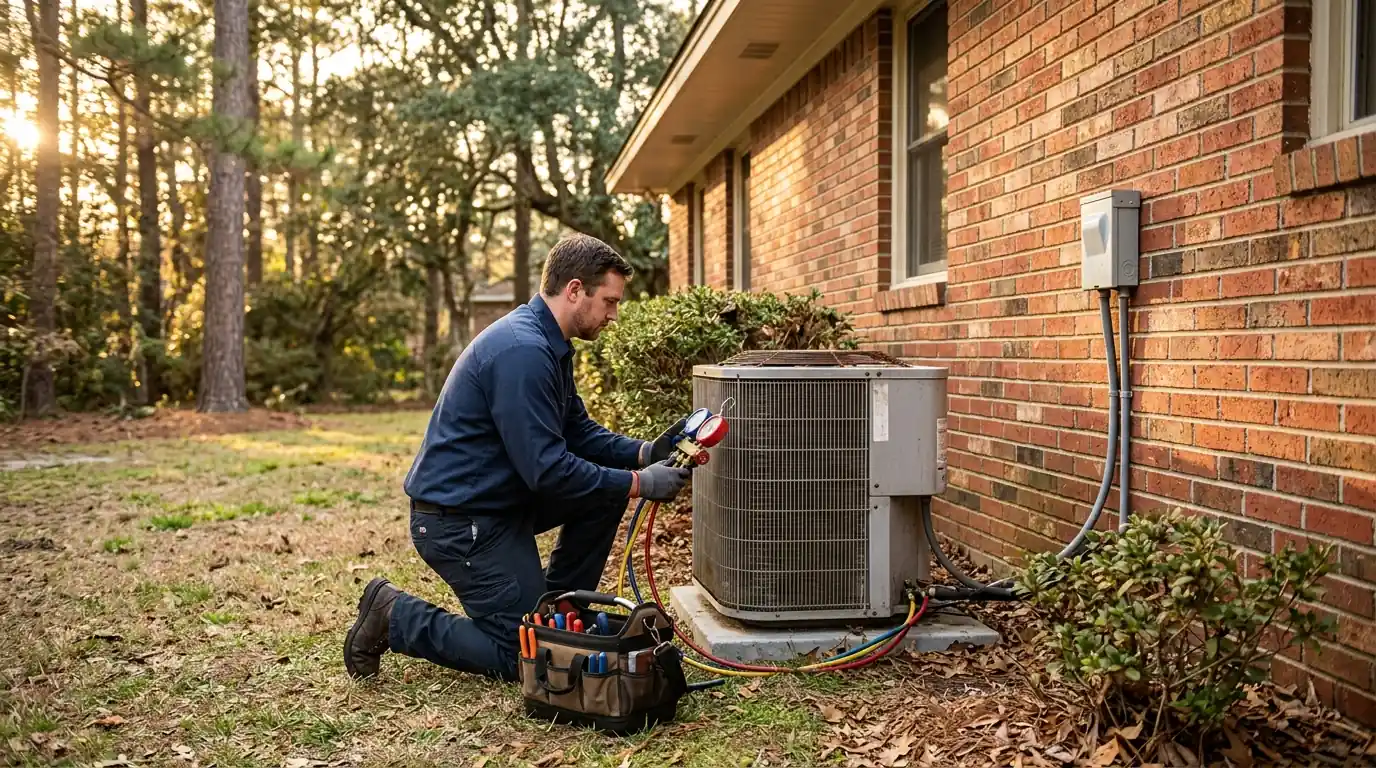
Indoor air quality testing in an Atlanta home measures humidity over several days, airborne particle counts room by room, and carbon monoxide and VOC levels near combustion appliances and finishes. The readings show whether the problem is moisture, dust, a gas appliance or off-gassing, which decides whether you need ventilation, filtration, dehumidification or a repair.
Indoor Air Quality Testing: what we check and why it matters
Most air quality complaints have a mechanical cause hiding in the house: a return duct pulling crawl space air, a bath fan venting into the attic, a furnace flue that does not draft, or a coil and drain pan growing film. Guessing leads to buying a purifier for a moisture problem or a dehumidifier for a duct leak.
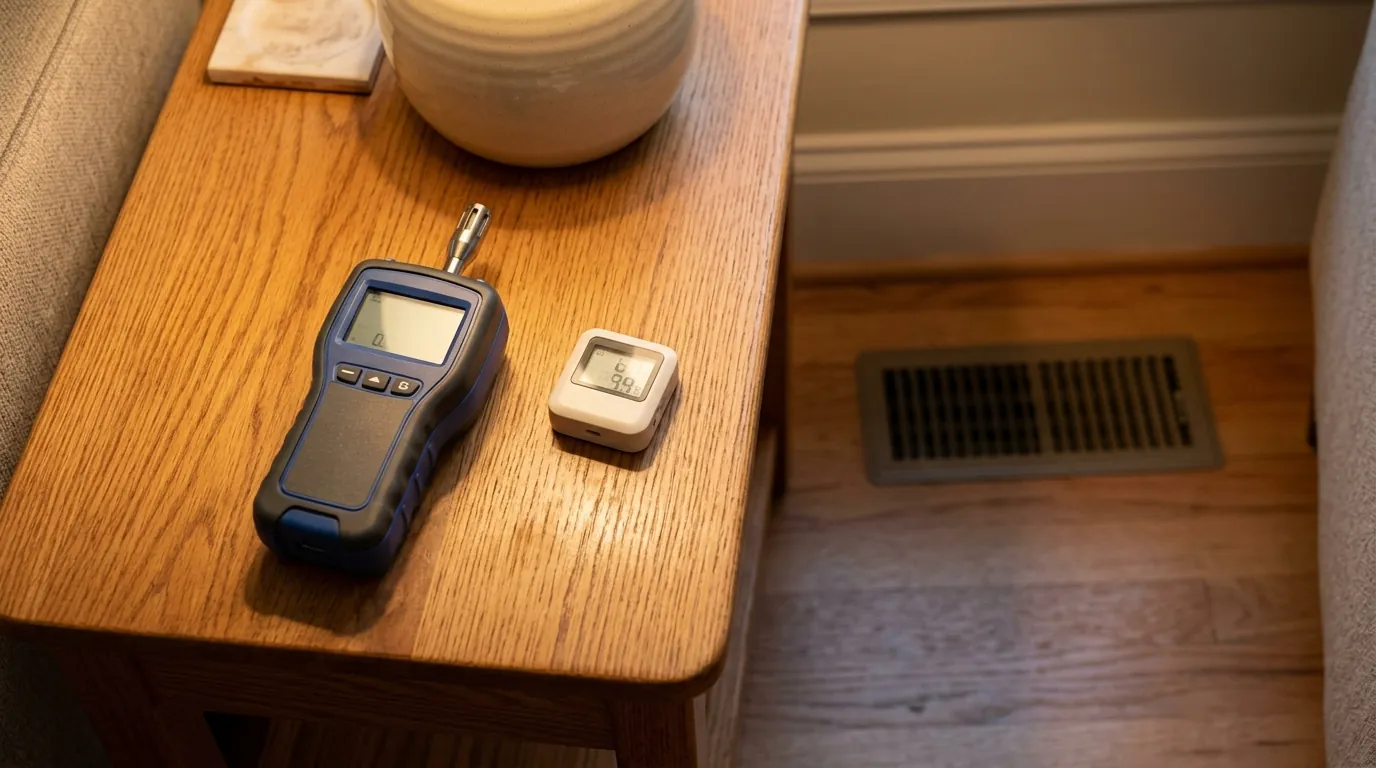
We test first, then explain what the numbers mean in plain terms. If the results point to equipment, such as a dehumidifier or a deeper filter, you will see why. If they point to a gas appliance, we treat that as a safety repair, not an upgrade.
What a thorough air quality assessment covers
Tests vary a lot between providers. A useful assessment includes most of these.
- Multi-day humidity logging, not a single reading
- Indoor and outdoor particle counts for comparison
- CO readings in living areas and near each gas appliance
- A flue draft check on gas furnaces and water heaters
- VOC screening where finishes or chemicals are stored
- A look at the coil, drain pan and blower wheel
- Return duct inspection for leaks in attics or crawl spaces
- A written summary of readings and likely causes
Humidity logging
If you notice clammy sheets, condensation on window glass, musty closets or warped trim, humidity is the first thing to measure. A single spot reading tells you little, so we leave small data loggers in the living area, a bedroom and the crawl space or basement for several days. The log shows when humidity climbs, whether it follows AC run time, showers or rain, and how close indoor surfaces come to the dew point. That pattern tells us whether the fix is ventilation, an AC adjustment, duct sealing or a dedicated dehumidifier.
Particle counts
Dust that comes back days after cleaning, or allergy symptoms that ease when you travel, call for particle counts. We use a handheld counter to measure fine and coarse particles in several rooms, at the return grille and outdoors for comparison. High counts near the return often point to a leaky return or a filter that air slips around. High counts in one room may trace to a disconnected duct in the attic. The readings also give a baseline, so after a filtration upgrade you can see whether the numbers actually came down.
Carbon monoxide and VOC readings
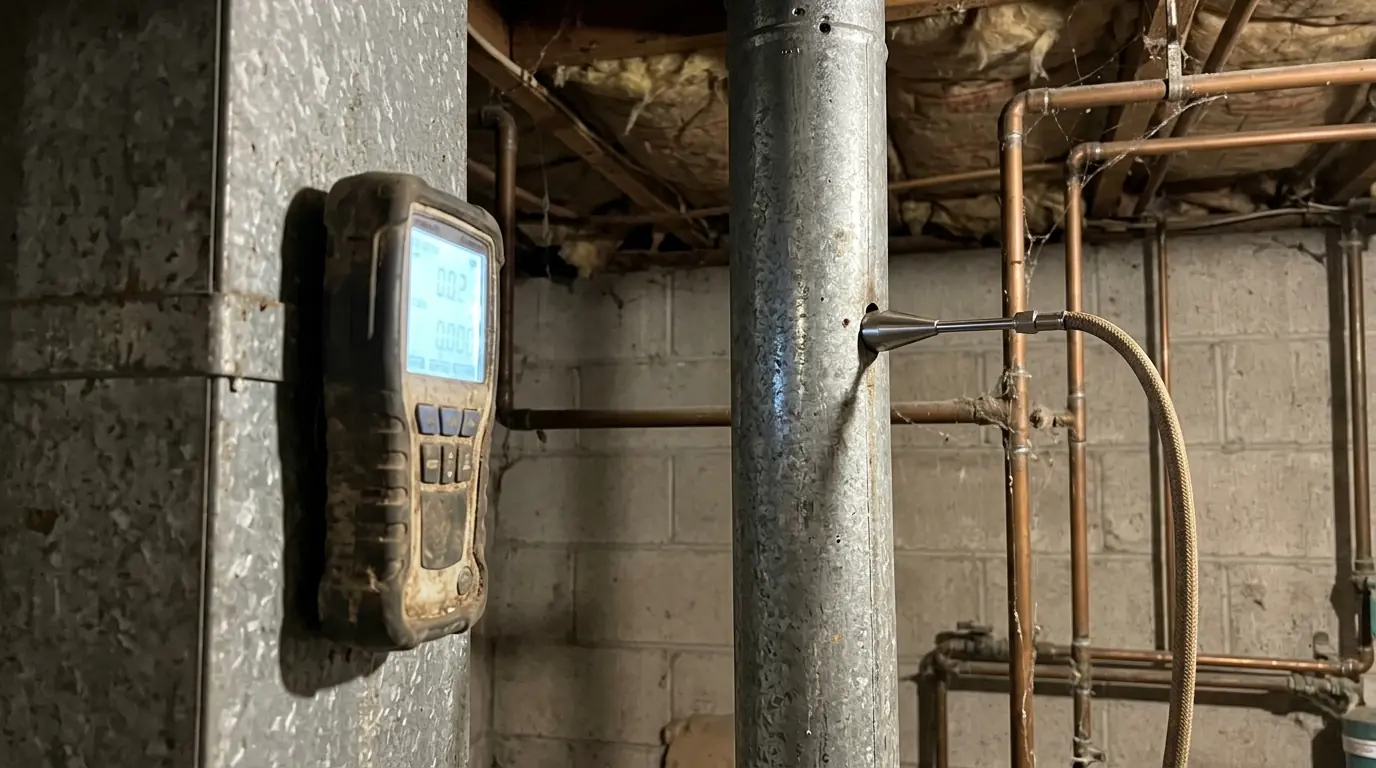
Headaches that fade outside, a burning smell in winter or a CO alarm that sounded once are reasons to test near combustion appliances. We take CO readings in the living space, at the furnace and water heater, and in the flue where it is safe to sample, and check that the flue drafts. VOC readings near new flooring, cabinets, paint or stored chemicals show whether off-gassing is behind a chemical smell. Any CO above background in the house gets traced to its source the same visit, and our gas furnace safety check covers the heat exchanger side.
What happens during an air quality visit
Hear the symptoms
We ask when and where the problem shows up, which rooms, which season, and whether it follows AC or heat run time.
Walk the mechanicals
We look at the air handler, filter rack, return ducts, bath fans, dryer vent and gas appliances before setting any meter.
Take baseline readings
We record particles, CO, VOCs, temperature and humidity indoors and outdoors to compare.
Leave loggers
Humidity loggers stay in place for several days so the data covers nights, showers and rainy weather.
Walk you through the results
We go over each number, the likely cause behind it, and the repair or equipment that would address it, if any.
What you can monitor yourself, and where meters fall short
Cheap monitors are useful for trends. They are not a substitute for tracing a gas appliance problem.
| Task | What you can do | Where a technician comes in |
|---|---|---|
| Watching indoor humidity | Yes, a basic hygrometer shows trends | Multi-room logging tied to AC run time |
| Testing for carbon monoxide | Keep working CO alarms on every level | Combustion and flue testing at each appliance |
| Checking dust levels | Consumer particle monitors show patterns | Calibrated counts plus duct and return inspection |
| Finding a chemical smell | Ventilate and remove obvious sources | VOC readings to confirm or rule out off-gassing |
Atlanta homes, weather and this job
Tighter houses near the airport change the air quality math. Hartsfield-Jackson's Noise Insulation Program treats eligible homes built before April 10, 1985 inside the 65 dB DNL contour, in places like Hapeville and College Park, with new windows and doors, air conditioning modifications and exhaust fans. Sealing an older house cuts noise and drafts, but it also keeps moisture, cooking gases and appliance exhaust indoors longer. In a treated home we pay close attention to whether exhaust fans move real air and whether a gas furnace or water heater still drafts properly.
Planning range for an air quality test
The range below is a published national planning figure, not our pricing. What gets tested decides where a visit lands in it.
| Job | Published planning range | Source |
|---|---|---|
| Indoor air quality testing visit | $303 to $616 | How Much Does Indoor Air Quality Testing Cost? [2025 Data] - HomeAdvisor |
What moves the number
- Number of rooms sampled
- Days of humidity logging
- Combustion and flue testing included
- VOC screening near finishes or storage
- Lab mold sampling if requested
These are ranges published by the sources linked above, shown for planning. They are not a quote and not our price; the real number depends on what we find at your home.
Indoor Air Quality Testing questions from Atlanta homeowners
Get everyone outside, call 911 or the gas utility from outdoors, and do not go back in until responders clear the house. After that, call us any hour to trace the source at the furnace, water heater or flue before the appliance runs again.
We look for the conditions mold needs: high humidity, wet coils, condensation on ducts and leaks. If you want spores identified by type, that takes lab sampling, which we can arrange as an add-on. Moisture readings usually tell you more about what to fix.
Several days at minimum, and longer is better. A short window can miss the pattern, such as humidity climbing overnight when the AC cycles less, or after rain when a vented crawl space pulls in wet air.
It tells you whether particles are the problem at all. If counts are high and the filter is weak, filtration usually comes first. If counts are fine but there is a smell or film on the coil, a coil UV light or purifier may fit. If humidity is the issue, neither helps much.
Yes. A return duct in a crawl space or attic with gaps pulls air from that space straight into the system. We check returns with the fan running, and sealing the joints often clears the odor.
New flooring, cabinets, paint and adhesives off-gas most in the first months, and tight new homes hold those gases longer. Readings tell you whether levels run high and whether the ventilation is moving enough fresh air to dilute them.
Updated October 2026