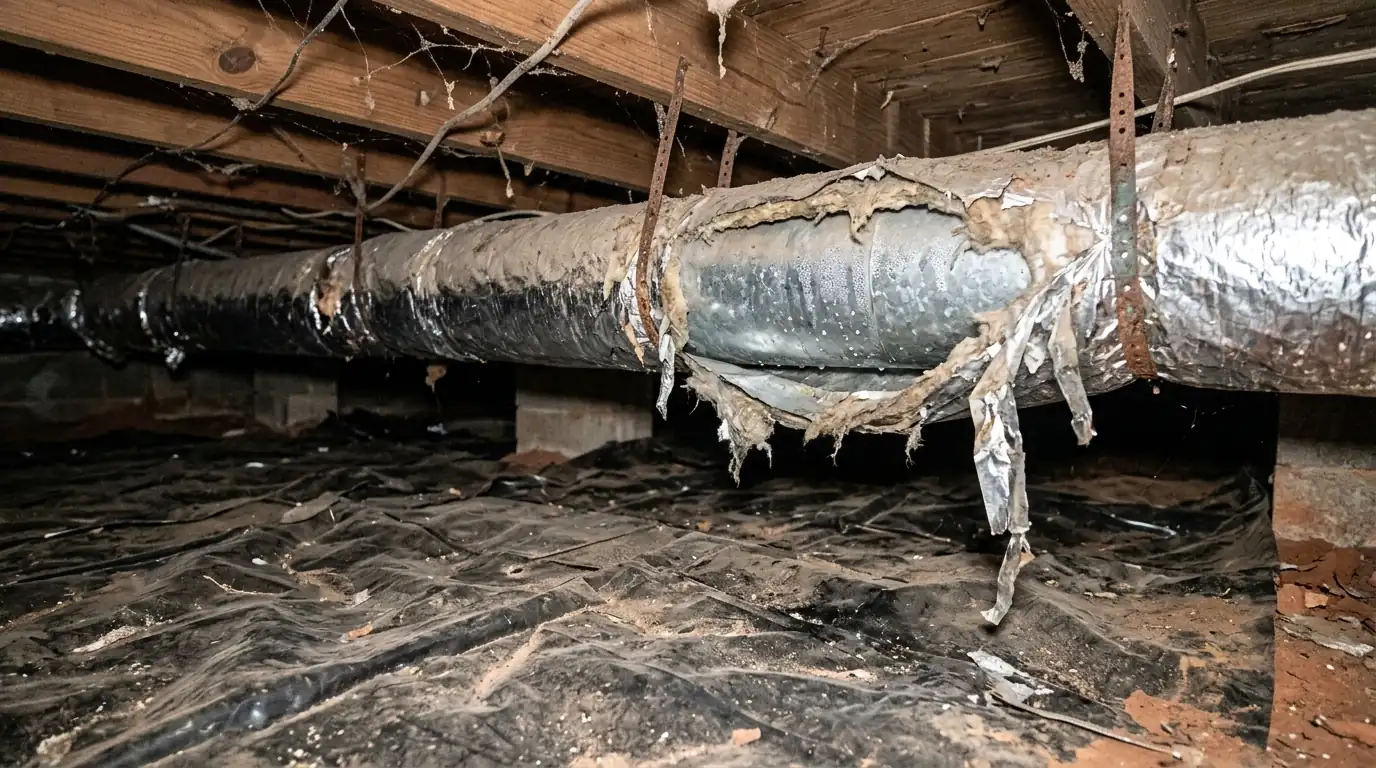
In Atlanta, a vented crawl space lets humid summer air under the house, where it meets cool duct surfaces and floor framing and condenses. With a July dew point near 68F, that means sweating ducts, damp insulation and musty odors pulled into the living space. Fixes run from repairing duct insulation to sealing the crawl space and adding a dehumidifier.
Why the space under the floor gets so wet
Older crawl spaces were built with vents in the foundation walls on the theory that outside air would dry them out. That works in a dry climate. In Atlanta it often works backward. Average relative humidity runs about 74 percent in July and August, and the average July dew point is close to 68F. When that warm, moist air enters a crawl space that sits several degrees cooler, it gives up water on every surface below its dew point.
The ground adds its own moisture. Bare soil, or a torn plastic vapor barrier, keeps releasing water vapor into the space all summer. The result is a crawl space that stays damp even in weeks without rain.
What that moisture does to your HVAC
Supply ducts carrying cooled air run well below the crawl space dew point in summer. If their insulation is torn, compressed or missing at the joints, the metal or the inner liner sweats. Water drips onto the soil or soaks into the insulation, which loses its value and gets heavy enough to pull runs loose.
The house itself pulls crawl space air upward through gaps around plumbing, wiring and duct boots. Leaky return ducts in the crawl space are worse, because they draw that damp, musty air straight into the system. Your air conditioner then has to remove the moisture again, running longer while the house still feels clammy.
Walk-through: what to look for under the house
A flashlight and a few minutes at the crawl space door can tell you a lot. Look for these:
- Beads of water or rust stains on metal ductwork and plenums
- Duct insulation sagging, wet to the touch or hanging in strips
- Flex duct lying on the soil or with its outer jacket torn open
- A vapor barrier with gaps, missing sections or standing water on top
- White fuzzy growth or dark spots on floor joists and subfloor
- A strong earthy or musty smell as soon as the door opens
- Crawl space vents blocked by soil or wide open behind shrubs
Repair options from small to complete
There is no single fix. The right one depends on how wet the space is and what the ducts look like. Start with the HVAC pieces you can address directly. Repairing crawl space ducts means reconnecting loose runs, sealing joints with mastic and replacing wet or damaged insulation so supply ducts stop sweating.
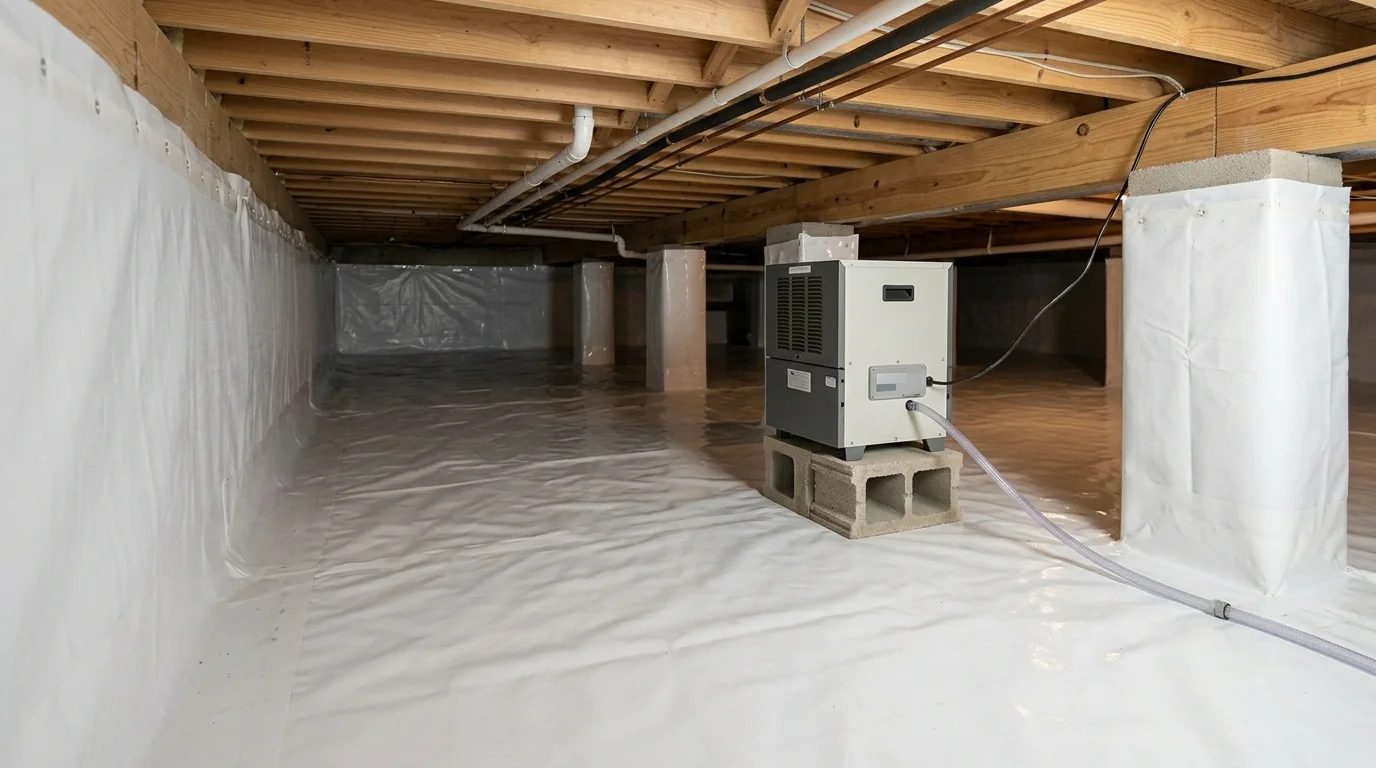
Next, deal with the ground moisture. A continuous, well-lapped vapor barrier over the soil and up the walls cuts the moisture source. On damp sites, that barrier is often followed by sealing the foundation vents and conditioning the space, which keeps it below the dew point year-round.
A sealed crawl space usually needs a moisture control device. A crawl space dehumidifier holds the humidity at a set level and drains to the outside or a pump. Some homes use a small supply of conditioned air instead. Either way, the space is treated as part of the house rather than as outdoors.
Tradeoffs of sealing a vented crawl space
Sealing and conditioning a crawl space is the more complete fix, and it often makes the floors above feel warmer in winter and the house drier in summer. It also takes ongoing attention. A dehumidifier needs its filter cleaned and its drain checked, and any plumbing leak or groundwater intrusion shows up as a humidity spike rather than drying out on its own.
Combustion equipment changes the picture. A gas furnace or water heater in a crawl space that draws combustion air from that space needs a safe air supply once vents are closed. That is a design question to answer before sealing, not after. A flue and combustion air check belongs in the plan whenever fuel-burning equipment shares the space.
When the problem shows up inside the house
Crawl space moisture often appears upstairs as a musty smell when the AC runs, cupping in hardwood floors, or a house that feels sticky at a normal thermostat setting. If indoor humidity stays high even with the AC running, the system may also be oversized or have airflow set too high to dry the air. Our guide on why drain lines clog in Atlanta humidity covers the condensate side of the same moisture load, and humidity logging over a week can show exactly when and where the moisture spikes.
Questions readers ask about this
Closing vents without other changes can trap moisture with no exit. Sealing works when it comes with a full vapor barrier and a dehumidifier or conditioned air supply. If you plan to close vents, treat it as part of a complete sealing project.
Yes. Damp air pulled up through the floor and leaky return ducts adds moisture the AC has to remove. That extra latent load keeps the system running longer, and rooms can still feel clammy at the thermostat setting.
Many contractors aim to keep it below about 60 percent relative humidity year-round, which limits mold growth on wood. A dehumidifier with a built-in humidistat holds that level automatically and runs more in summer.
It is often mold or mineral deposits, a sign of persistent moisture. It needs drying and the moisture source fixed, and visible growth should be cleaned by someone equipped for it. Air from that space reaching the house is reason enough to address it.
In July the outdoor dew point is high and the ducts carry cold air, so any gap in insulation sweats. By October the dew point drops and the AC runs less, so condensation slows or stops. The leak in the insulation is still there.
Possibly. The two spaces often have different moisture sources and air paths. One unit can sometimes serve both if they are connected, but separate units are common. Humidity readings in each space show which approach fits.
Services this article points to
Duct Repair & Sealing
Duct repair and sealing in Atlanta mostly means finding air lost before it reaches the rooms: flex duct crushed or kinked in the attic, runs that have slipped off their collars, and joints leaking at every seam.
Whole-Home Dehumidifiers
A whole-home dehumidifier in Atlanta pulls out the moisture your AC leaves behind, usually holding indoor humidity between 45 and 50 percent.
Indoor Air Quality Testing
Indoor air quality testing in an Atlanta home measures humidity over several days, airborne particle counts room by room, and carbon monoxide and VOC levels near combustion appliances and finishes.
Gas Furnace Safety & CO Testing
A gas furnace safety check in Atlanta tests whether combustion gases leave the house the way they should: through an intact heat exchanger and a flue with steady draft.