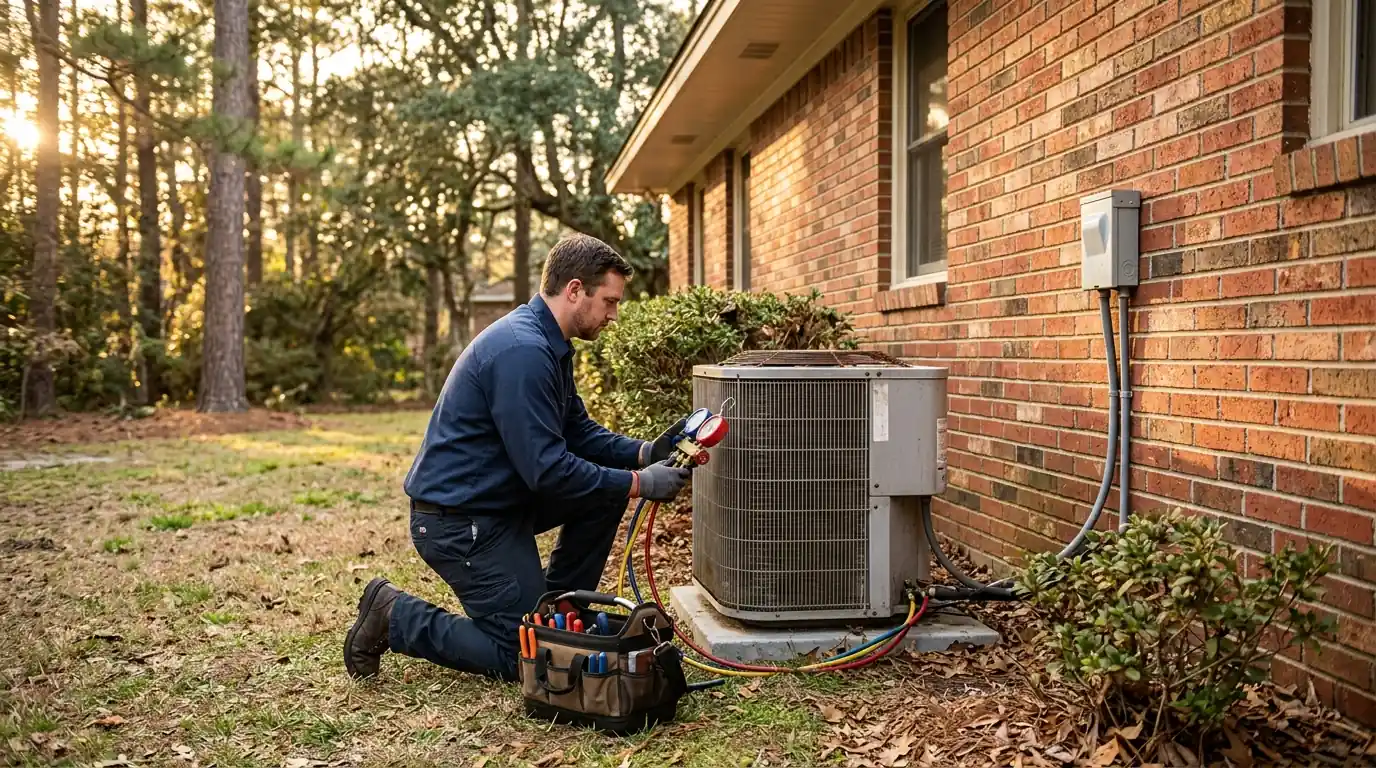
Refrigerant leak repair in Atlanta starts with finding the leak, because refrigerant runs in a sealed loop and never wears out. We use electronic detectors, bubble solution and standing nitrogen pressure tests to pinpoint it, then decide whether a brazed repair, a valve core, or a coil replacement is the honest fix.
Refrigerant Leak Repair: what we check and why it matters
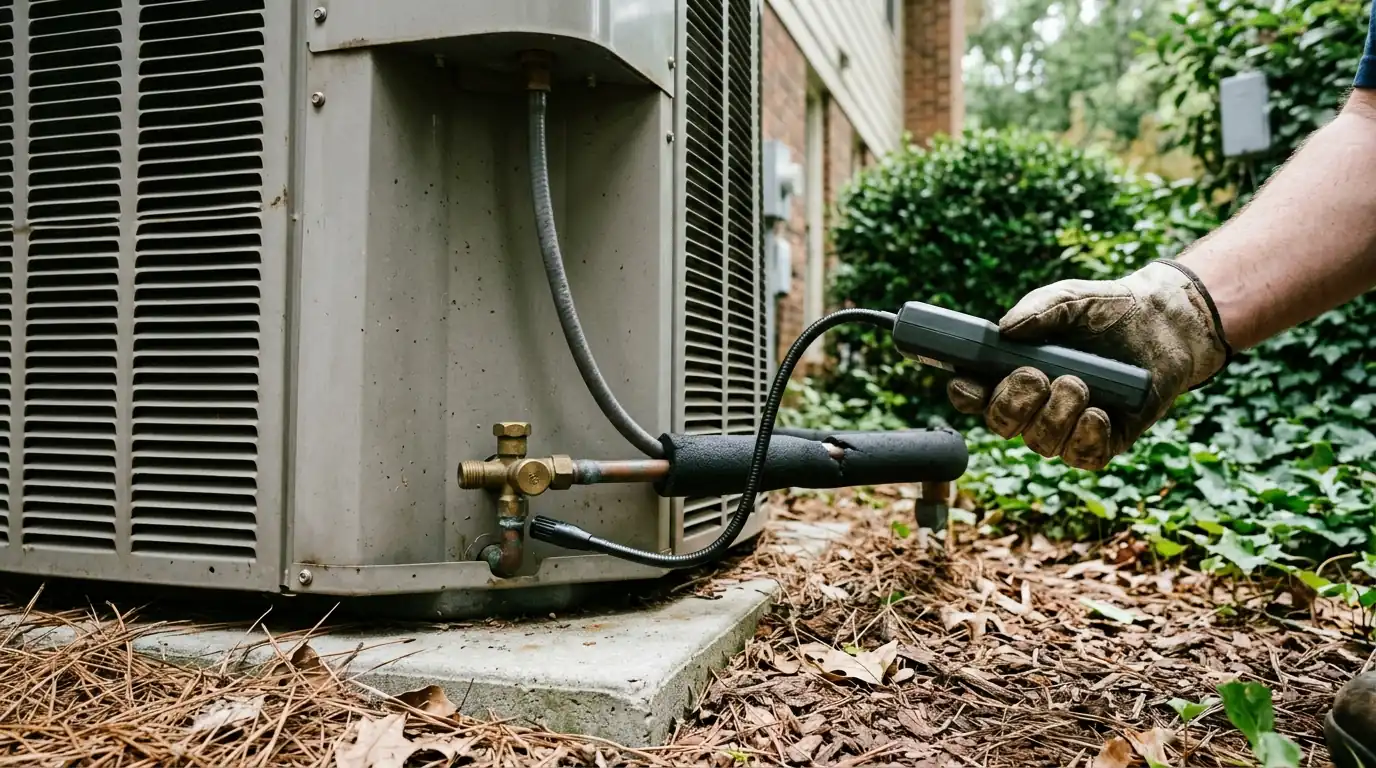
Leaks show up at predictable spots: flare nuts and Schrader cores at the service valves, brazed joints near the compressor, rub-throughs where a line set touches the cabinet, and pinholes in the indoor coil. Some can be fixed in place. A coil eaten by corrosion usually cannot, and patching it only moves the leak to the next tube.
The refrigerant in your system changes the math. R-22 is no longer produced, so every pound comes from reclaimed supply. R-410A is still serviced but is being phased down. For the background, read our guide to R-22, R-410A and R-454B.
Repair the leak or replace the coil?
Where the leak is often decides the answer.
| Repair in place | Replace the component | |
|---|---|---|
| Common leak spots | Service valves, flare nuts, line set joints | Corroded indoor coil, condenser coil |
| Typical outcome | Leak sealed if the metal is sound | New metal, no hidden pinholes |
| When it fits | Single leak on a younger system | Multiple leaks or formicary corrosion |
| Risk | Another leak nearby later | Higher upfront cost |
Published leak repair and recharge ranges
National planning ranges from a published cost guide, not our prices. The location of the leak matters more than anything else.
| Job | Published planning range | Source |
|---|---|---|
| Refrigerant leak repair | $200 to $1,500 | How Much Does AC Repair Cost? (2026) - HomeGuide |
| Refrigerant recharge | $100 to $600 | How Much Does AC Repair Cost? (2026) - HomeGuide |
What moves the number
- Leak location: service valve, line set, condenser or indoor coil
- Refrigerant type and pounds needed
- Whether recovery and a nitrogen test are required
- Attic or crawl space access to the leak
These are ranges published by the sources linked above, shown for planning. They are not a quote and not our price; the real number depends on what we find at your home.
Electronic leak search
With the system running, we sweep the coil, line set and condenser with a heated-diode electronic detector, moving slowly with the probe beneath each joint because refrigerant is heavier than air. A hit narrows the search, and bubble solution confirms the exact spot on accessible joints. Indoor coils are harder: the leak is often buried in the coil face behind the drain pan. If the charge is too low to find a leak at operating pressure, we move to a nitrogen test. Each confirmed leak gets marked and explained before any repair starts, so you know what you are paying to fix.
Nitrogen pressure testing
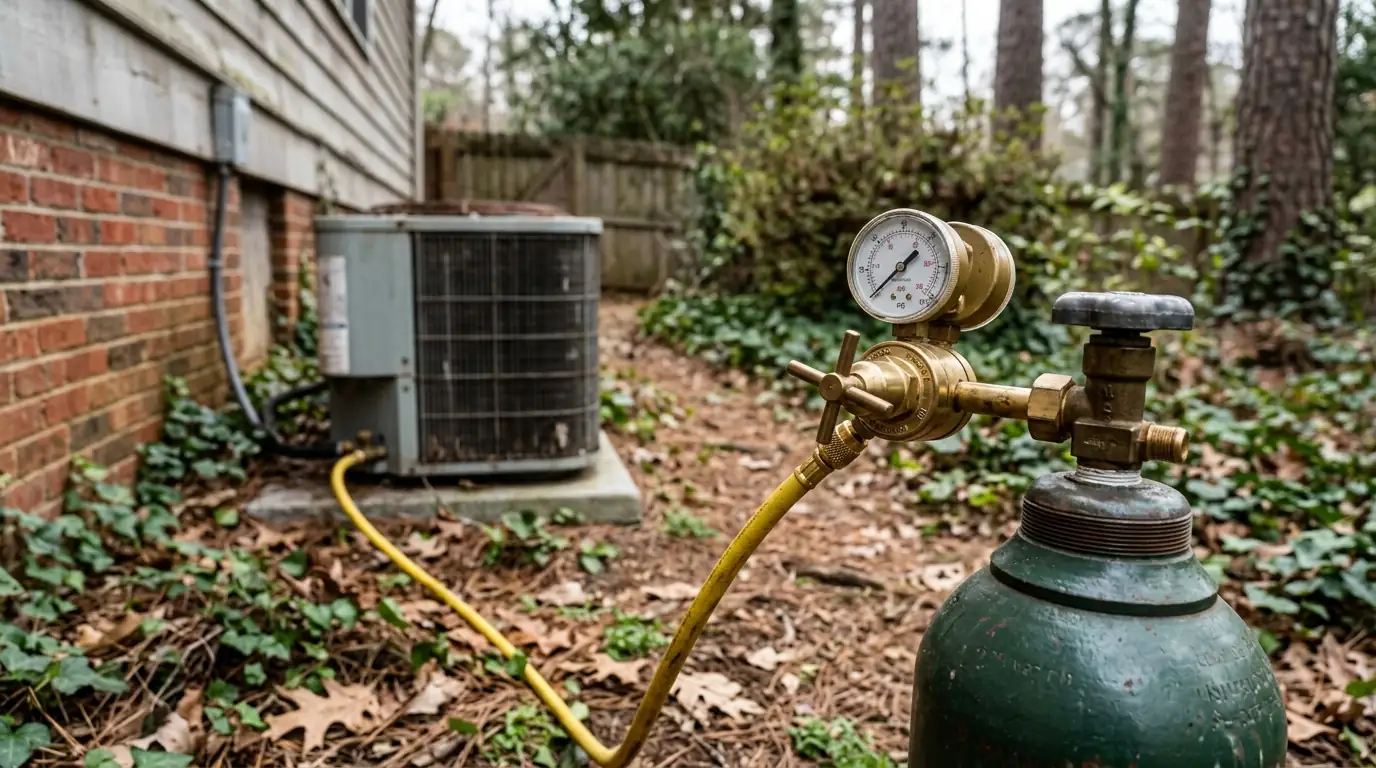
When a leak is too small to find at operating pressure, we recover the remaining refrigerant and pressurize the system with dry nitrogen, often to several hundred psi depending on the equipment's test rating. A standing pressure drop over time proves a leak exists, and isolating the indoor and outdoor sections tells us which side holds it. After a brazed repair, the same test confirms the joint before we evacuate with a vacuum pump and recharge. Skipping this step is how a system gets charged twice in one season.
Older R-22 systems
R-22 equipment is usually fifteen years old or more, and its refrigerant comes only from reclaimed stock, so recharging is expensive and supply varies. A single leak at a service valve on an otherwise healthy unit may still be worth repairing. A leaking coil on an R-22 system rarely is, because an R-22 replacement coil is scarce and the rest of the system is near the end of its life. We will lay out both paths. If replacement makes more sense, our AC replacement page explains what moving to a current system involves.
R-410A and newer A2L systems
R-410A systems are the bulk of what we repair, and leaks in them are usually worth fixing when the system is under twelve years old. Newer systems running R-454B or R-32 are mildly flammable A2L equipment, so leak repair follows stricter handling: ventilation during brazing, leak detectors rated for A2L gases, and attention to the refrigerant sensor many of these indoor units carry. The diagnosis is the same, but the tools and procedures are not interchangeable, and we bring the right ones for the refrigerant on the data plate.
How we find and fix a refrigerant leak
Confirm the charge is low
Superheat, subcooling and operating pressures tell us whether low charge is really the problem or airflow is.
Search with a detector
An electronic sniffer sweeps every joint, valve and coil face, and bubble solution confirms hits.
Isolate with nitrogen
For stubborn leaks we pressure-test each side of the system separately to find the section that drops.
Repair the leak
Joints are brazed under a nitrogen purge, cores replaced, or the failed component swapped.
Evacuate and recharge
We pull a deep vacuum, check it holds, then weigh in refrigerant to the factory charge.
The local side of refrigerant Leak Repair
Federal refrigerant rules changed again in 2026. On May 21, EPA lifted the original January 1, 2026 installation deadline for residential R-410A equipment built before 2025, so R-410A systems remain common and serviceable around Atlanta. Their replacements, R-454B and R-32, are A2L refrigerants. The federal rule does not require homeowners to replace a working system, which means a leak on a sound R-410A unit is a repair decision, not a forced upgrade.
How a refrigerant leak usually shows itself
Refrigerant has no smell you will notice, so watch for these effects.
Cooling fades over weeks
The system runs longer every day and the house still creeps up.
Ice on the outdoor lines
Low charge drops coil temperature below freezing and frosts the suction line.
Hissing near the unit
A larger leak can hiss at a valve or coil while the system runs.
Oily stains on copper
Refrigerant carries oil, so a leaking joint often looks wet or dusty.
Higher power bills
A short charge stretches run time for the same cooling.
A recharge last year
If refrigerant was added before, the leak was never fixed.
Refrigerant Leak Repair questions from Atlanta homeowners
We avoid sealant additives. They can clog the metering device, contaminate recovery equipment and make a later repair harder. A small pinhole might hold for a while, but the leak is still there. Finding and repairing it costs more once and less over the life of the system.
R-410A and R-22 are not toxic in household amounts, but in a closed space they displace oxygen. Newer A2L refrigerants are mildly flammable, which is why equipment using them carries sensors and design limits. If you smell something burning or chemical near the indoor unit, turn the system off and call us.
A leak at an accessible valve or joint is often found within an hour. A pinhole buried in an indoor coil can take longer, especially if it needs a nitrogen standing test, and occasionally a second visit to read the pressure drop. We tell you where we are in the search as we go.
Many coils use thin copper tubes that corrode from the inside out in a pattern called formicary corrosion, triggered by household chemicals and humidity. The pinholes are tiny and spread. Repairing one often reveals the next, which is why evaporator coil replacement is sometimes the more reliable fix.
Yes, with reclaimed R-22, though supply is limited and the cost per pound is high. Before committing, we compare that recharge against the age and condition of the rest of the system. On a unit near the end of its life, money spent on R-22 is often better spent on replacement.
Often, yes. Lower pressure means a colder coil, and below freezing the moisture on it turns to ice and blocks airflow. A frozen coil can also come from a dirty filter, so check that first. See our AC repair page for what to do while the coil thaws.
Updated October 2026