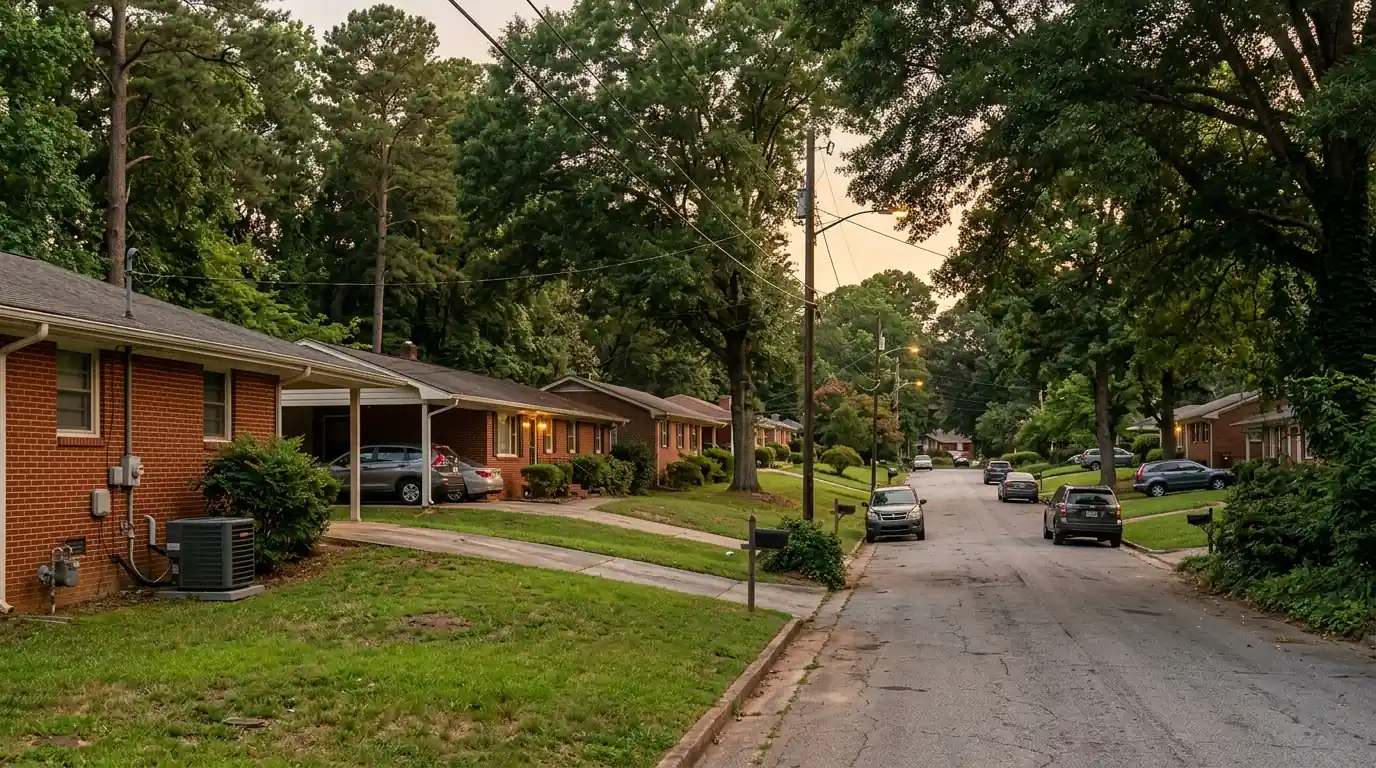
Cascade Heights homes get AC repair, furnace and heat pump service, and duct work from us, and the large houses on hilly lots here usually need airflow balanced across many rooms more than raw cooling power. The neighborhood's heavy tree canopy shades roofs but drops pollen and leaves into outdoor units, so coil cleaning matters every year.
Large houses on hilly lots under a deep tree canopy
Cascade Heights joined Atlanta in 1953 and is known for large homes on spacious, hilly lots under the city's second densest tree canopy. That shade is a real advantage in July. A roof and condenser sitting in shadow for much of the afternoon carry less heat load than the same equipment baking in open sun.
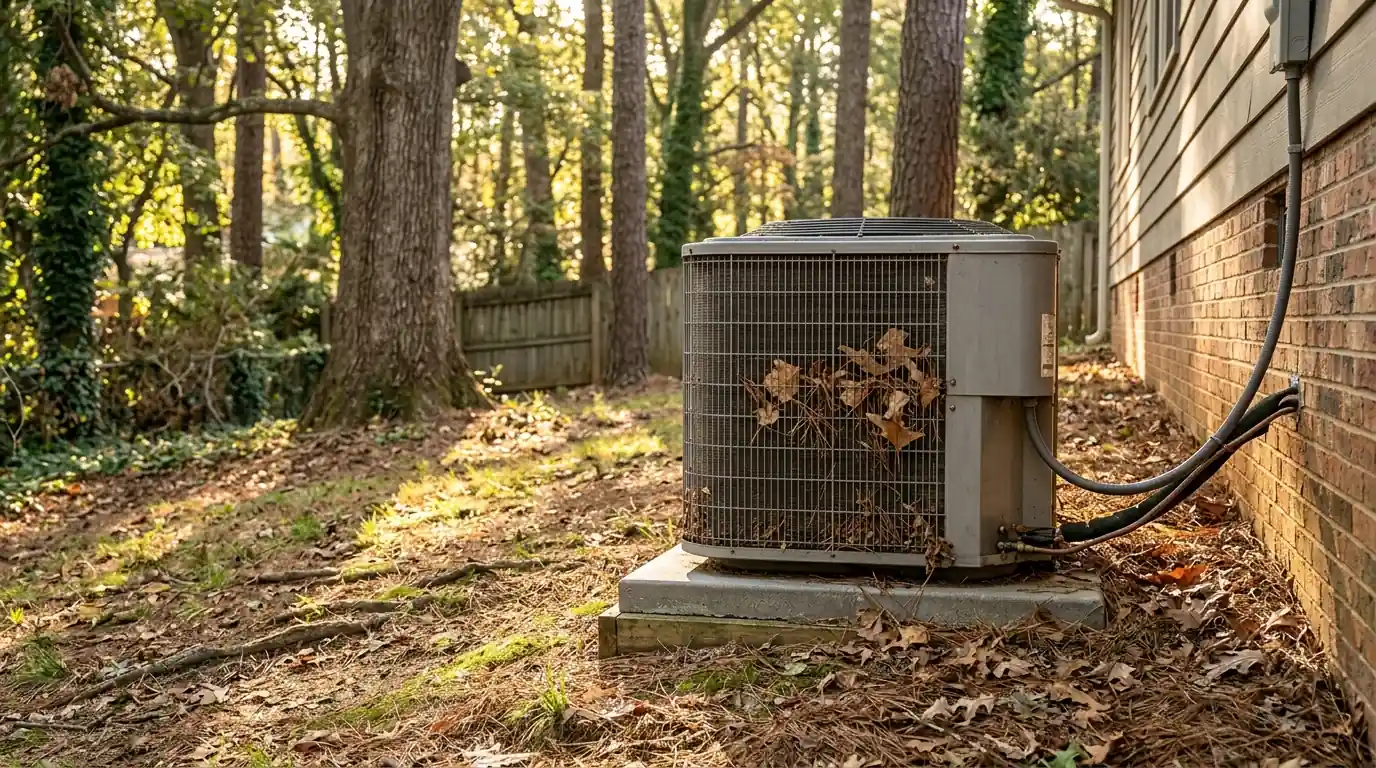
The tradeoff shows up in the outdoor unit. Leaves, twigs and seed pods settle into the condenser fins, and on a sloped lot the concrete pad can sink or tilt over time. Manufacturers expect the condenser to sit close to level, so we check the pad and the line set as part of any visit here.
Postwar subdivisions and interwar streets need different fixes
The neighborhood is not one housing era. Subdivisions such as Peyton Forest, Audubon Forest, West Manor, Sewell Manor and Mangum Manor were carved from old farms during the 1950s building boom, while the streets around Adams Park and Beecher Hills began developing between the two world wars.
A house from the 1950s may still run on duct runs laid out for its first forced-air system, sized for a different blower and leaking at many seams by now. An interwar house was built before central air was common in homes, so whatever ductwork it has was added later and routed wherever it would fit. We measure static pressure and trace the layout before recommending new equipment in either kind of house.
What 44 days over 90F does to a big house
Atlanta now averages about 44 days a year at 90F or hotter, and relative humidity in July and August averages about 74 percent. In a large house that means long cooling cycles, and each one depends on the evaporator coil pulling moisture out of the air, not only dropping its temperature.
When a big house feels cool but clammy, the cause is often an oversized system that satisfies the thermostat before it dries the air, or a blower set too fast for the coil. We check airflow across the coil and the condensate drain before anyone talks about a new system. Sometimes a whole-home dehumidifier is the right answer for the far end of the house.
Oak, pine and sweetgum season under the Cascade canopy
Atlanta's spring pollen peak comes mainly from oak, pine, sweetgum and sycamore trees, and a canopy as dense as this one puts plenty of it at your door. Pollen loads a filter fast and coats the outdoor coil with the same yellow film you see on the driveway.
Check the filter every few weeks from March into May, and have the condenser coil rinsed once the pollen drops. Our pollen season filter guide covers which MERV rating your system can handle without starving the blower of air.
Heating and cooling work that fits Cascade Heights, Atlanta
AC Repair
Long summer run times in large houses put steady wear on capacitors, contactors and condenser fan motors.
AC Tune-Up & Maintenance
Leaf litter and spring pollen from the canopy foul condenser coils, so a yearly coil cleaning pays off here.
Duct Repair & Sealing
Postwar subdivision houses can still carry early duct runs that leak at joints and take-offs.
HVAC Zoning Systems
Big floor plans with rooms far from the air handler are good candidates for zone dampers and a second thermostat.
Whole-Home Dehumidifiers
Shaded houses that cool easily can still hold humidity when the system short-cycles.
Whole-Home Air Filtration
A media filter cabinet handles heavy oak and pine pollen loads better than a thin one-inch filter.
Cascade Heights heating and air questions
Shade lowers the cooling load, which is exactly why we run a load calculation instead of copying the old tonnage. A house under heavy canopy may need less capacity than a similar house in full sun, and an oversized unit short-cycles and leaves the air damp. We size from the house, not the old data plate.
It can be. Manufacturers expect the condenser to sit close to level, and a pad that has sunk on one side strains the refrigerant lines where they leave the cabinet. We can relevel or replace the pad and check the line set for rubbing or kinks while we are there.
Long duct runs lose air and pressure before they reach the end of a big house, especially if a joint has separated along the way. We measure supply temperature and airflow at the problem rooms and at the trunk. The fix ranges from resealing one connection to a zoning system with motorized dampers.
Check a one-inch filter every two to three weeks from March through May and change it when it looks coated, not on a calendar date. A four- or five-inch media filter in a proper cabinet lasts longer and restricts airflow less. Either way, rinse the outdoor coil after the yellow dust settles.
Sometimes. If the main sheet metal trunk is sound, resealing its joints and adding insulation can give it more years, while old branch runs are often undersized or crushed. We inspect and measure static pressure first, then tell you which runs to keep and which to replace before new equipment goes in.
Updated October 2026