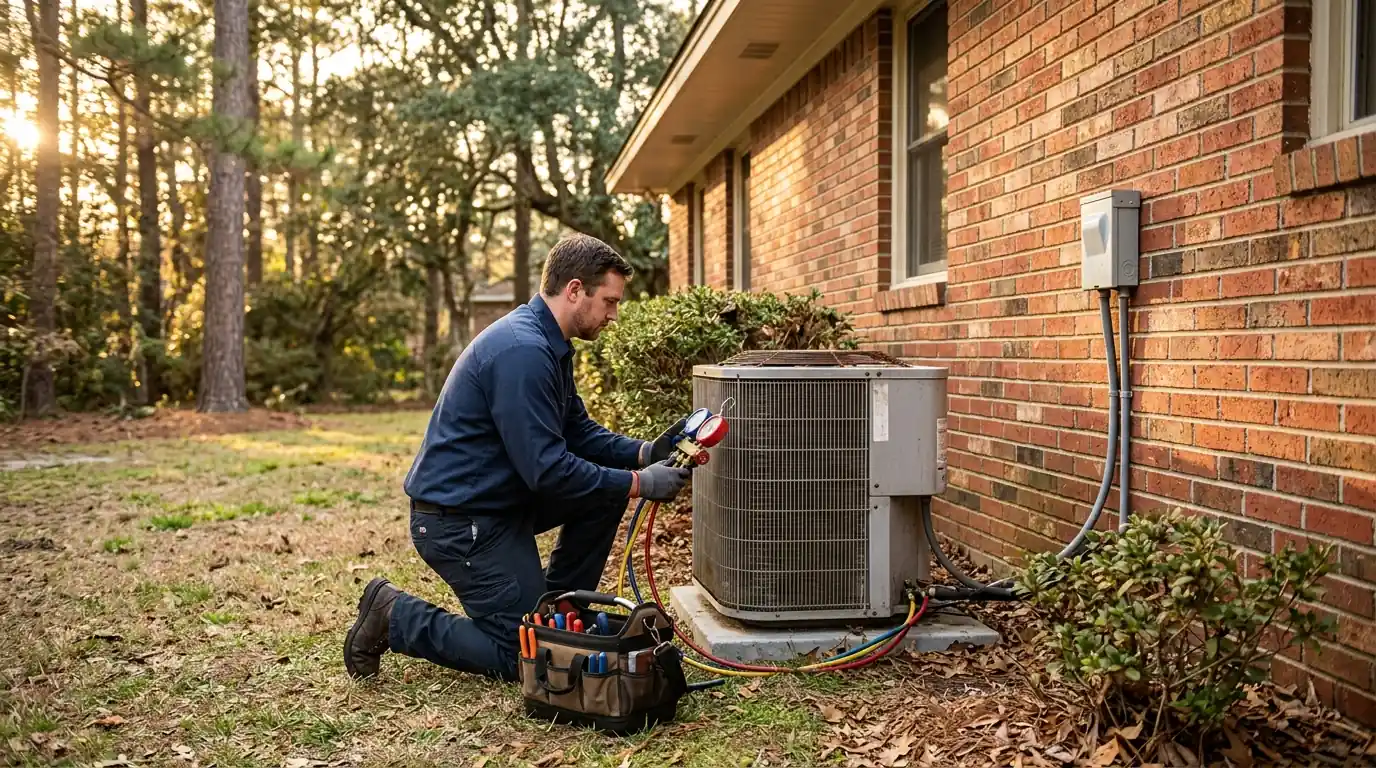
Blower motor replacement in Atlanta starts with ruling out the cheaper fixes: a weak run capacitor on a PSC motor or a failed control module on an ECM motor. When the motor itself has failed, we match the replacement to the system's airflow needs, not just the shaft size, and clean the blower wheel while it's out.
Blower Motor Replacement: what we check and why it matters
The blower moves every bit of air in a central system, in both heating and cooling. When it stops, the outdoor unit can keep running with no air across the coil, which freezes it in summer, and a furnace shuts down on its high limit in winter. Turn the system off until it's fixed.
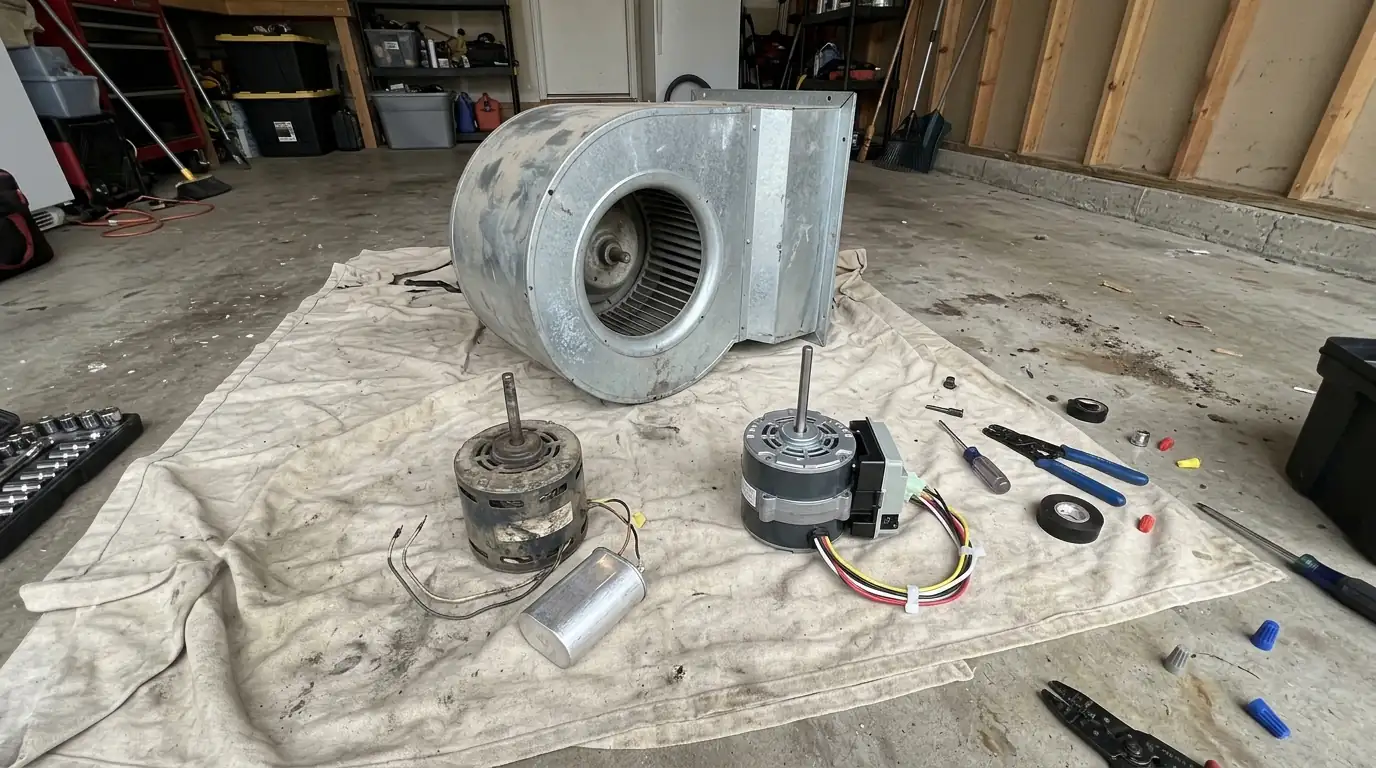
Blower trouble often starts elsewhere. A clogged filter, crushed ducts or a dirty wheel make the motor work harder and run hotter. If static pressure is high, we'll point it out, because a new motor on the same restriction wears out early. Duct repair or duct replacement may be the real fix.
Signs the blower motor is failing
Most blower problems announce themselves with sound, smell or airflow.
Humming with no airflow
Weak capacitor or seized bearings.
Squealing or grinding
Worn bearings or a wheel rubbing the housing.
Burning smell at the furnace
An overheating motor winding.
Weak airflow at every register
Dirty wheel, failing motor or wrong speed tap.
Blower starts slowly
A capacitor losing its rating.
Blower runs nonstop
A stuck board relay or fan setting, not always the motor.
How long a blower motor swap takes
Most blower motor replacements take a couple of hours once the part is on hand. Common PSC motors and universal replacements are easy to find. Brand-specific ECM motors and modules sometimes have to be ordered, which can stretch the job to another visit. If the system is down in a heat wave or freeze and the exact motor isn't available, we can often fit a temporary universal motor to get air moving while the right part arrives.
PSC and ECM blower motors
PSC motors are the older, simpler type: a fixed-speed motor with a run capacitor, with speed taps chosen by wire. They're inexpensive but lose efficiency at lower speeds. ECM motors are electronically commutated, with a control module that varies speed and holds airflow steady as filters load. Many newer systems use them, and they draw far less power. When a PSC motor fails, we can often replace it with the same type or a direct-replacement ECM. When an ECM fails, sometimes only the module needs replacing, and it must be programmed for the system.
Capacitor-only fixes
A PSC blower motor needs its run capacitor to start and run. As the capacitor weakens, the motor starts slowly, runs hot and may hum without turning. Replacing a capacitor costs little next to a motor. We measure its microfarad value against the rating on the label, and spin the motor by hand to check for bearing drag. If the capacitor is weak and the bearings are smooth, a capacitor alone may solve it. If the bearings are rough, the motor is near its end anyway.
Blower wheel cleaning
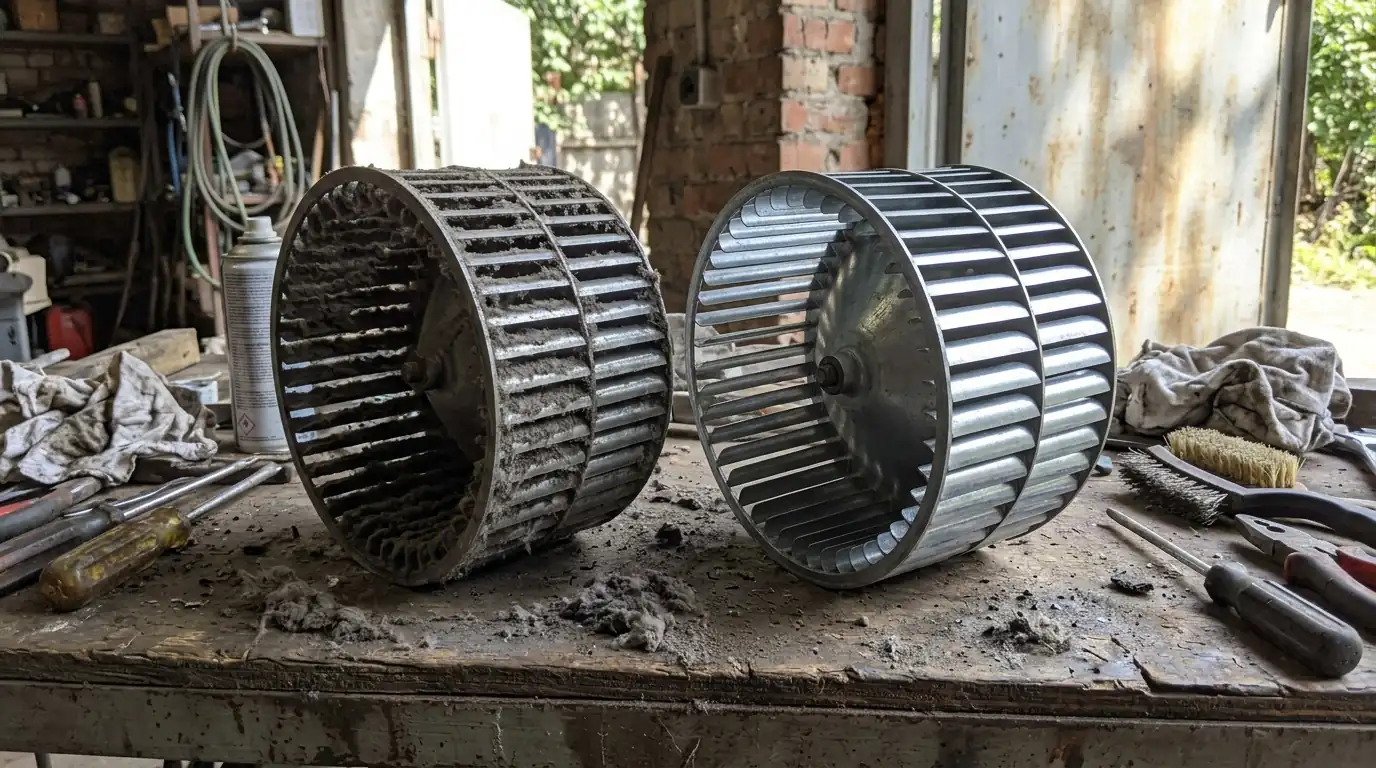
The squirrel-cage blower wheel collects dust on each curved blade. Even a thin layer cuts airflow noticeably, because the blades lose their shape. A heavily caked wheel can also throw the assembly off balance, wearing bearings. When we replace a motor, we pull the wheel and clean it. On some service calls, a clean wheel restores airflow without a new motor, which is why we look at the wheel before condemning anything. In humid months, dust on damp blades can also hold moisture and add a musty smell at startup. A wheel that's cracked, rusted or loose on its hub gets replaced.
How we diagnose and replace a blower motor
Check the call
We confirm the board is sending the fan signal and line voltage is reaching the motor.
Test the capacitor or module
We measure capacitance on a PSC motor or check the ECM module's response.
Pull the assembly
We remove the blower housing, check bearings and inspect the wheel.
Replace and clean
We fit the matched motor or module, clean the wheel and balance it on the shaft.
Measure airflow
We run each speed and check amps, static pressure and temperature split.
Equipment brands we service and install
Most homes around Atlanta run equipment from a handful of major manufacturers. We diagnose, repair and replace Carrier, Trane, Lennox, Goodman, Rheem and Daikin systems, along with the other names below.
Brand names are shown to describe the equipment we work on. We are not claiming a dealer or factory relationship with any manufacturer.
Where this shows up around Atlanta
A blower motor in an Atlanta system runs most of the year. The cooling season starts early and runs long, and in humid weather the blower often runs at lower speed for longer periods to pull moisture out of the air. Then it turns around and moves heated air through the winter. That adds up to many more running hours than the same motor would see in a milder climate. It's one reason we check blower amps and capacitor values on every service visit, not just when something fails.
Replace a PSC motor in kind or upgrade to ECM
When a PSC motor fails, there's a choice.
| Same-type PSC motor | Direct-replacement ECM | |
|---|---|---|
| Upfront cost | Lower | Higher |
| Running power draw | Higher | Lower |
| Airflow as filters load | Drops | Holds steadier |
| Fits well when | System is near the end of its life | System has years left |
Blower motor replacement cost ranges
The published range below covers full blower motor replacement. A capacitor-only or ECM module fix falls well below it.
| Job | Published planning range | Source |
|---|---|---|
| Blower motor replacement | $500 to $2,300 | How Much Does AC Repair Cost? (2026) - HomeGuide |
| Typical HVAC repair visit | $150 to $650 | How Much Does AC Repair Cost? (2026) - HomeGuide |
What moves the number
- PSC or ECM motor
- Motor, module or capacitor only
- Brand-specific ECM programming
- Furnace or air handler access
- Blower wheel condition
These are ranges published by the sources linked above, shown for planning. They are not a quote and not our price; the real number depends on what we find at your home.
Blower Motor Replacement questions from Atlanta homeowners
No. With no air moving over the coil, it freezes into a block of ice, and liquid refrigerant can flood back to the compressor. Turn the system off at the thermostat until the blower is fixed.
Often because the original cause was never fixed: high static pressure from undersized ducts or a clogged filter, a dirty wheel, or a weak capacitor. We check those when we replace a motor so the new one isn't working against the same problem.
Yes, especially at lower speeds and when the fan runs for long periods. The savings are biggest when you run the fan continuously for filtration or humidity control.
The motor type is similar, but mounting, speed taps and controls differ. A furnace blower also has to move enough air to keep the heat exchanger within its temperature rise. We match the replacement to the unit, not just the frame size. See repairs to the indoor air handler for the indoor unit.
The motor itself usually isn't rebuilt in the field. But many failures that look like the motor are actually a capacitor, a module, a relay or a dirty wheel, and those are fixed without replacing the motor.
Usually dry or worn bearings that loosen once the motor warms up. On older belt-driven blowers, it can also be a slipping belt. Either way, bearings get worse, so it's worth having checked before it seizes.
Updated October 2026