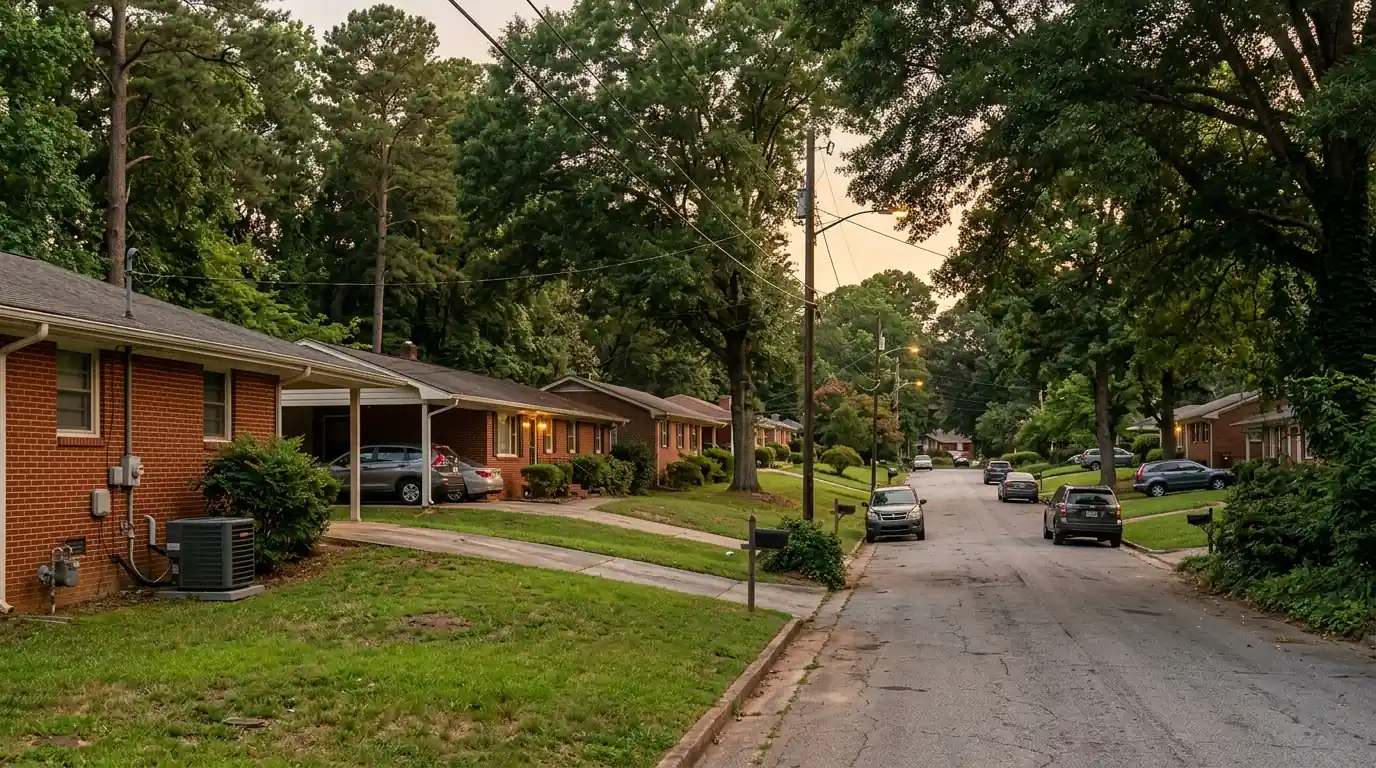
College Park homes get AC repair, new installations and heating service from us, and the city's two housing stories drive most decisions. Historic houses built between 1882 and 1946 need cooling routed into homes never designed for ducts. Homes treated under the airport's noise program are sealed tight, so their AC must be sized for the closed-up shell and kept dry.
Cooling 853 historic resources
College Park's 606-acre National Register historic district holds 853 historic resources, mostly built between 1882 and 1946 in Queen Anne, revival and Craftsman styles. Those houses have tall ceilings, plaster walls and floor plans built for cross breezes, not ductwork.
Cooling them well usually means one of three paths: conventional ducts through the attic and crawl space with a properly sized return, small-duct high-velocity systems, or ductless mini-splits for rooms that ducts cannot reach without cutting into trim. Each has tradeoffs in cost, noise and how much the house changes. We walk the attic and crawl space with you before recommending one.

Homes the airport sealed up
Hartsfield-Jackson's Noise Insulation Program treats eligible homes built before April 10, 1985 inside the 65 dB DNL contour, and College Park is on the list. Treatments can include new windows and doors, air conditioning modifications and exhaust fans. A 2021 Georgia Municipal Association brief says the airport has spent more than $65 million on noise mitigation for nearby structures, and College Park leaders want another round of insulation funding.
For HVAC, a treated home behaves differently. With windows staying closed, the AC carries the cooling and the moisture load, and exhaust fans carry stale air out. When we replace a system in one of these houses we size it to the treated shell. An oversized unit short cycles and leaves rooms clammy even at 72F.
Water mains, freezes and a backup plan
The Christmas 2022 freeze brought burst pipes across metro Atlanta, including a major main break affecting East Point and College Park supply. Historic homes with crawl spaces and long plumbing runs are the ones most exposed when the heat goes out.
Heating work here ranges from furnace repair to heat pump service, and we answer the phone 24/7. College Park sits in Fulton County beside East Point and Hapeville, which share the airport program.
Heating and cooling work that fits College Park
Ductless Mini-Split Installation
Mini-splits cool rooms in College Park's Queen Anne and Craftsman houses without cutting into original plaster.
AC Replacement & Installation
Noise-treated homes need replacement systems sized to the tighter shell to avoid short cycling.
Ductwork Replacement
Pre-1946 houses often carry ducts added piecemeal that need a proper layout and return.
Whole-Home Dehumidifiers
Crawl space humidity and sealed living spaces both call for moisture control beyond the AC.
AC Repair
Closed-up airport-area homes keep the AC running long hours, so worn parts fail sooner.
Gas Furnace Safety & CO Testing
A tight, treated house leaves less margin for a poorly venting gas furnace.
College Park heating and air questions
Often, yes. Supply ducts can run through the attic and crawl space with registers in floors and ceilings, small-duct systems use narrow flexible tubes, and ductless heads mount on walls. The right choice depends on the attic, the crawl space and how much visible equipment you accept.
According to a 2021 Georgia Municipal Association brief, College Park leaders want another round of insulation funding, and the airport has already spent more than $65 million on nearby noise mitigation. Eligibility depends on the home being built before April 10, 1985 inside the 65 dB contour. The airport program office decides eligibility.
If the AC was not changed during treatment, it may now be oversized for the tighter house. Signs include short run times, clammy rooms and uneven upstairs temperatures. We run a load calculation on the treated house before recommending a size.
Historic homes often have open crawl spaces where humid summer air meets cold supply ducts and condenses. Torn duct insulation and missing vapor barrier make it worse. Reinsulating ducts and controlling crawl space moisture usually stops the dripping.
Placement in a National Register district can draw attention, so many owners put condensers at the side or rear of the house out of the street view. We plan the location with line set length, drainage and service clearance in mind, and you should confirm any local design review with the city.
Updated October 2026