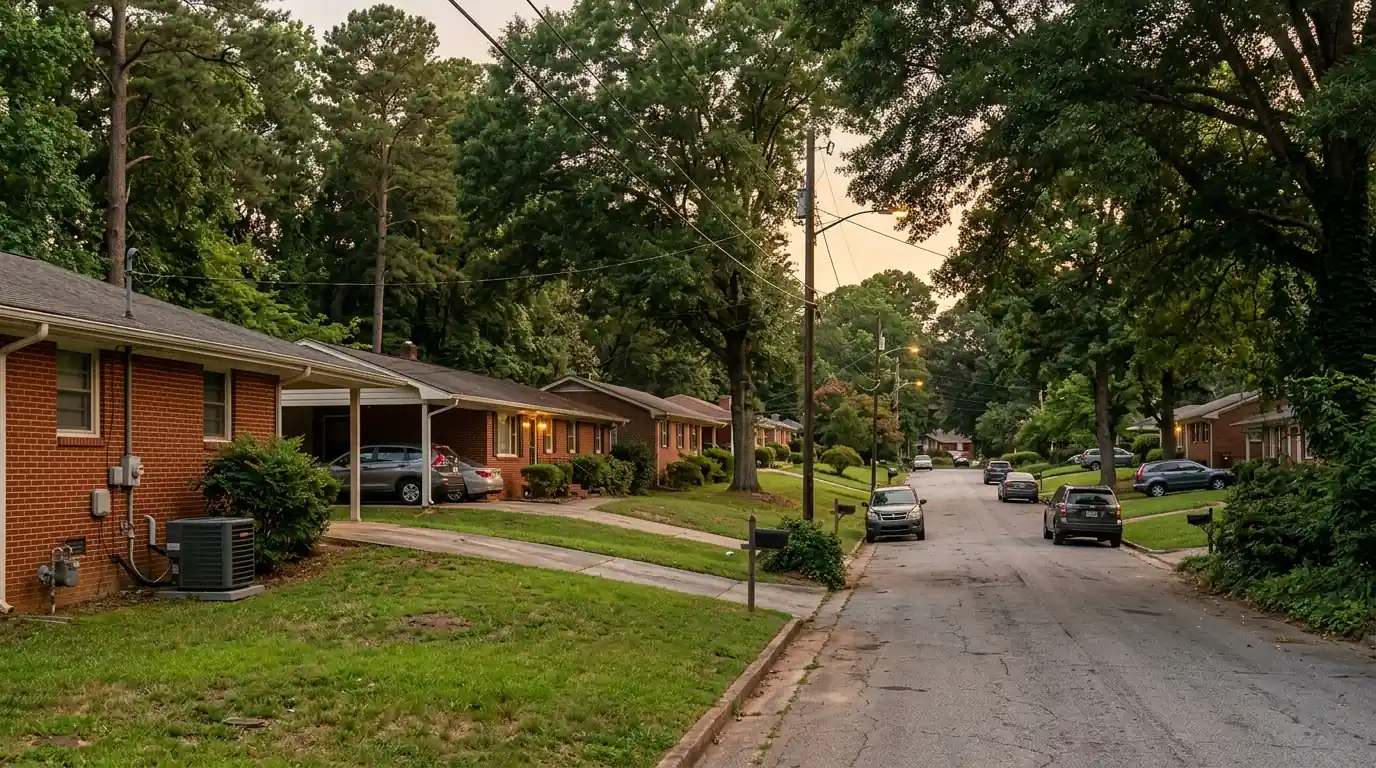
Peyton Forest gets AC repair, AC replacement and heating service from us. It was one of the Cascade Heights subdivisions carved from old farms in the 1950s postwar boom, so houses here have had time to go through several generations of equipment. The main question is often whether to repair the current system or replace it under today's efficiency and refrigerant rules.
A 1950s subdivision on its latest round of equipment
Peyton Forest was carved from old farmland during the 1950s building boom, alongside Audubon Forest, West Manor, Sewell Manor and Mangum Manor. A house built then has had time to outlive several air conditioners, and the parts installed along the way do not always match each other.
Mismatches are common in homes this age: a newer condenser paired with an older indoor coil, or a furnace replaced on its own while the AC stayed. A mismatched pair can run, but it rarely reaches its rated efficiency, and the coil is often the weak point. We read every data plate before talking about repair or replacement.
Repair or replace: the numbers we look at
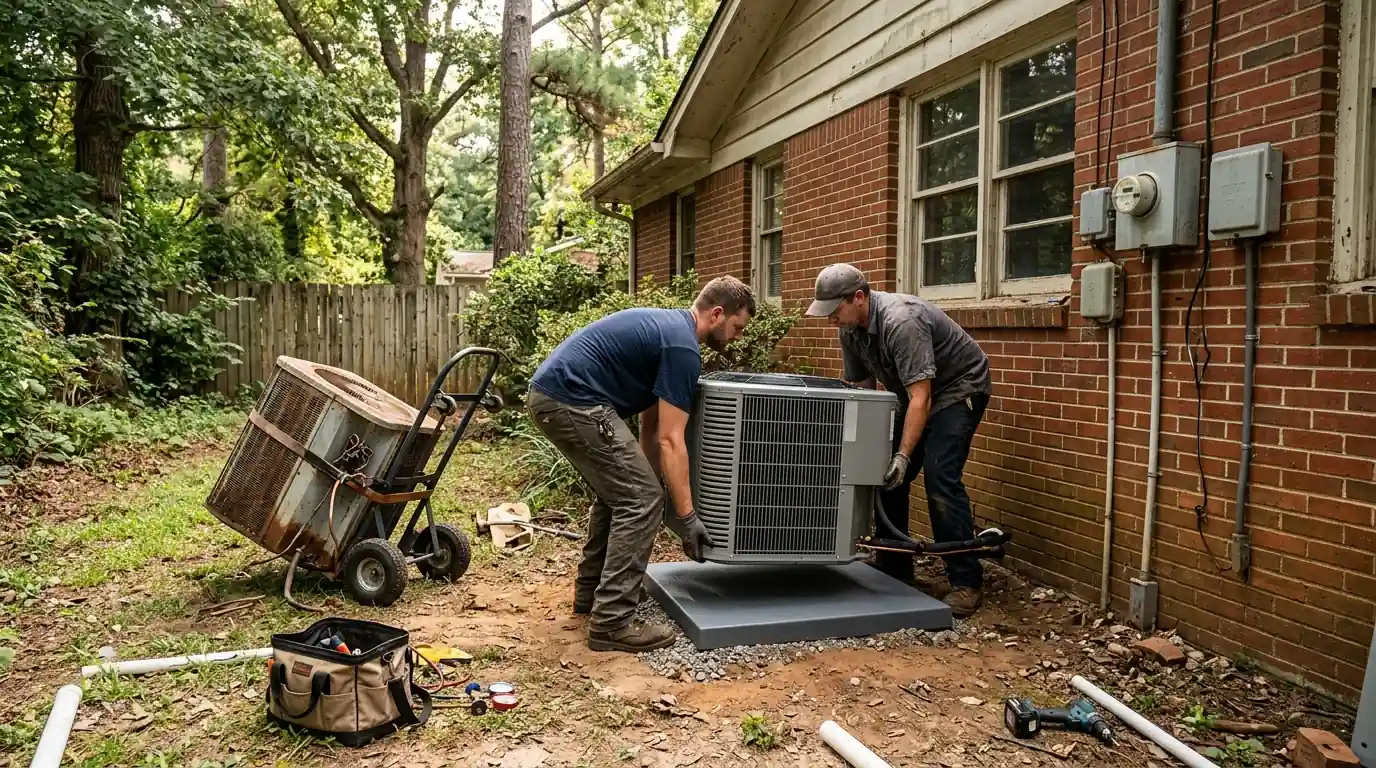
We start with the failed part and the age of the system around it. A capacitor, contactor or fan motor on a system with years left is a repair. A failed compressor or leaking coil on an older R-22 or early R-410A unit deserves a side-by-side look at a full system replacement.
Since January 1, 2023, a split-system AC installed in Georgia must meet 14.3 SEER2 below 45,000 Btu/h and 13.8 SEER2 at or above it, judged by installation date rather than manufacture date. Our article on SEER2 minimums explains what those numbers mean when you compare new systems.
Refrigerant changes and what they mean for your next AC
New residential systems manufactured from January 1, 2025 must use refrigerant with a GWP of 700 or less, which in practice means R-32 or R-454B instead of R-410A. Both replacements are rated A2L, mildly flammable, so they come with different handling practices during installation and service.
EPA's May 2026 rule lifted the original January 1, 2026 installation cutoff for R-410A equipment built before 2025, so some of that equipment can still go in. Nothing requires you to replace a working system. When a replacement is on the table, we lay out both refrigerant paths and what each means for future repairs.
Summers that test a new installation from day one
Atlanta's record high of 106F came on June 30, 2012, and by mid-September 2026 the city had already logged 71 days at 90F or above. A new system here has to be sized for those afternoons without being so large that it short-cycles through the humid spring and fall months.
That is why we run a load calculation instead of matching the old tonnage. Brick ranches in Collier Heights from the same postwar years raise the same sizing questions, and the rest of Cascade Heights shares Peyton Forest's subdivision roots.
Heating and cooling work that fits Peyton Forest, Atlanta
AC Replacement & Installation
When a major part fails on an older unit, a replacement sized by load calculation is worth pricing side by side.
AC Repair
Capacitors, contactors and fan motors fail on hot afternoons and are usually straightforward repairs.
Evaporator Coil Replacement
An older indoor coil paired with a newer condenser is a common source of leaks and lost efficiency.
Refrigerant Leak Repair
Pinpointing a leak first tells you whether a repair will hold before you spend on refrigerant.
Furnace Replacement
Matching a new furnace to the AC avoids the mismatched pairs common in homes on several rounds of equipment.
HVAC Inspection for Home Buyers
Buyers can learn system age and refrigerant type from the data plates before closing.
Peyton Forest heating and air questions
Sometimes, but it is often a false saving. A new condenser needs a matched indoor coil to reach its rating, and a newer refrigerant cannot go into a coil designed for another one. If your coil is recent and compatible, condenser-only can work. We check the coil model before recommending it.
Georgia sits in the Southeast region, so a split-system AC installed now needs at least 14.3 SEER2 under 45,000 Btu/h and 13.8 SEER2 at larger sizes. The rule follows the installation date, so older stock cannot go in below those levels. Higher ratings cost more upfront and pay back through lower summer bills.
It depends on when the equipment was made. Systems manufactured from 2025 on use low-GWP refrigerants such as R-454B or R-32, while R-410A equipment built before 2025 can still be installed under EPA's 2026 rule. We tell you which one a proposed system uses and what that means for future service.
With a room-by-room load calculation that accounts for insulation, windows, orientation and where the ducts run. If insulation or windows have been upgraded since the last system went in, the old tonnage may now be too big. An oversized unit cools fast but leaves the air damp and cycles hard.
Usually not. The compressor is the most expensive part of the condenser, and on a system that age the coil, fan motor and other parts are near the end too. We give you repair and replacement options side by side so the choice is yours. Our compressor replacement page explains when a repair still makes sense.
Updated October 2026