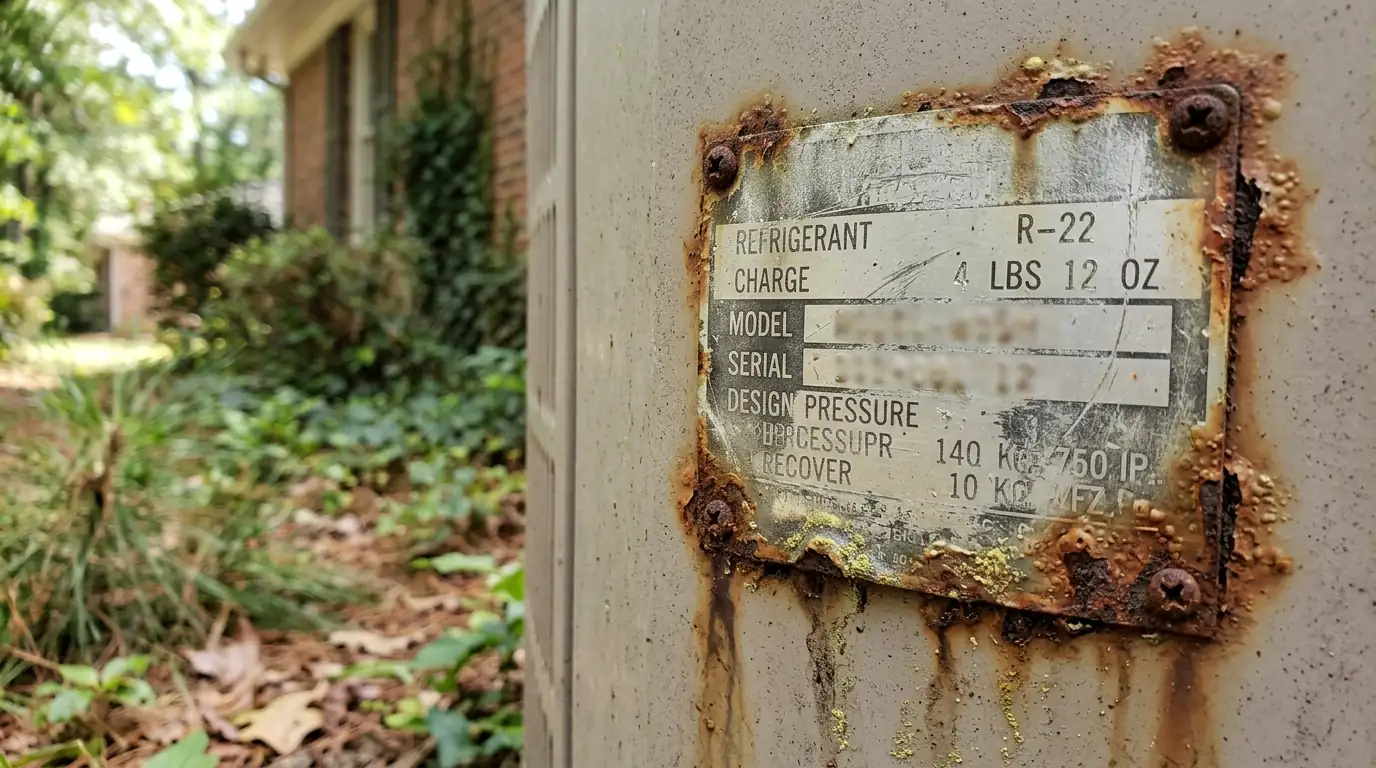
Your existing R-410A or R-22 system can legally keep running and be repaired. Since January 1, 2025, newly manufactured home AC and heat pump systems must use refrigerant with a GWP of 700 or less, which is why R-454B and R-32 are now common. On May 21, 2026, EPA also lifted the planned 2026 install cutoff for R-410A equipment built before 2025.
Three generations of refrigerant in one paragraph
R-22 was the standard in older home air conditioners and has long been phased out of new equipment. R-410A replaced it and became the default for new installs in recent years. It is non-flammable, rated A1, but it carries a global warming potential (GWP) of 2,088. The replacements now arriving, R-454B with a GWP of 466 and R-32 with a GWP of 675, sit under the federal limit of 700. Both are classed A2L, meaning mildly flammable.
Each refrigerant runs at its own pressures and needs matching oils, components and charging procedures. You cannot top off one system with another refrigerant, and you cannot pair an outdoor unit built for one with an indoor coil built for another.
What actually changed in 2025 and 2026
Under EPA's Technology Transitions rule, written under the AIM Act, new residential and light commercial AC and heat pump systems must use refrigerant with a GWP of 700 or less. The compliance date for manufacture and import was January 1, 2025. Systems whose components were all made or imported before that date have no installation deadline under that rule.
The original rule also set a January 1, 2026 date after which those older R-410A systems could no longer be installed. On May 21, 2026, EPA finalized a reconsideration rule that lifted that 2026 installation prohibition for residential and light commercial R-410A equipment built before 2025. Variable refrigerant flow systems, a commercial category, have a January 1, 2027 installation date. In practice, a new R-410A system built before 2025 can still be installed, but no new R-410A residential systems are being built.
If your system runs on R-22
Most R-22 systems in Atlanta are well into their second decade. They can still be serviced with reclaimed refrigerant, but supply is limited and each pound is expensive. A small leak that would be a routine fix on a newer system becomes a hard financial question on an R-22 unit.
Our honest view: on an aging R-22 system, a leak search is worth doing if the leak is at an accessible fitting or valve core. If the leak is in the indoor coil or the compressor is weak, the money usually goes further toward a full split-system replacement than toward another charge.
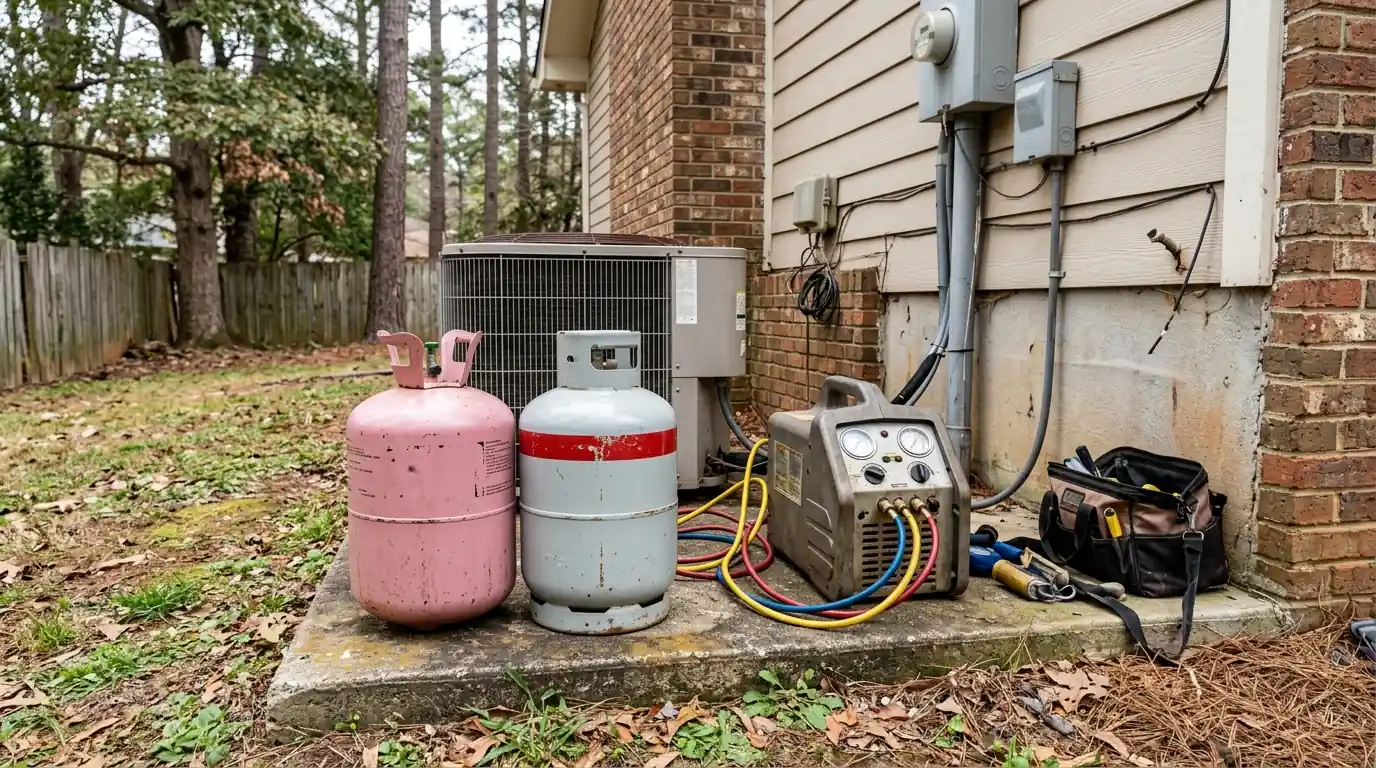
If your system runs on R-410A
Nothing in the federal rules forces you to replace a working R-410A system. It can be repaired, recharged and maintained for the rest of its life. Service refrigerant will remain available for existing equipment, although industry observers expect prices may rise as production steps down.
Partial replacements are the tricky part. If your R-410A condenser dies but the coil is fine, a matched replacement condenser may be harder to source over time, and a new A2L condenser cannot run on your R-410A coil. When a refrigerant leak repair or compressor job comes up, ask how the age and refrigerant of the indoor coil affect the options.
What A2L refrigerants mean inside your house
Mildly flammable sounds alarming, so it helps to be precise. A2L refrigerants need a specific concentration and a strong ignition source to burn, and equipment designed for them includes leak detection sensors and mitigation controls that run the blower to disperse refrigerant if a leak is sensed.
For installers, A2L work means using rated recovery machines and tools, following charge limits for the room size, and handling cylinders correctly. For homeowners, it mostly means leaving refrigerant work to trained technicians, which was already the rule. Refrigerant handling is federally regulated regardless of type.
Questions to ask when a technician mentions refrigerant
These questions keep the conversation concrete, whether the issue is a repair or a replacement budget.
- Which refrigerant does my system use, as printed on the outdoor unit data plate?
- Where is the leak, and was it found with an electronic detector, bubbles or a nitrogen pressure test?
- How much refrigerant was added, and is that consistent with a leak or a one-time loss?
- If I replace only the outdoor unit, will it match the coil I have?
- If I replace the system, which refrigerant will the new one use?
Questions readers ask about this
No. The federal rule applies to newly manufactured equipment, not to working systems already installed in homes. You can keep repairing and maintaining an R-410A system. Replacement becomes a choice based on age, repair cost and efficiency, not a legal requirement.
Not with a simple swap. The pressures, oils and metering devices are different, so the outdoor unit, indoor coil and often the line set must change together. Some drop-in substitutes exist for R-22, but they change performance and should be weighed carefully.
Yes, when installed to the manufacturer's charge limits and with the required leak detection. Equipment sized for A2L refrigerant accounts for room volume and includes controls that circulate air if refrigerant is sensed. Follow-through on proper installation is the safety measure.
Look at the data plate on the outdoor unit, usually a metal or foil label near the service panel. It lists the refrigerant type and the factory charge. If the plate is faded, the model number tells a technician the refrigerant.
Not soon. Production is being stepped down, but reclaimed and existing supply will serve installed systems for years. Prices may rise, which makes finding and fixing leaks more important than repeated top-offs.
The indoor coil carries refrigerant, oil and a metering device sized for one refrigerant. A new A2L condenser needs a coil rated for its pressures and refrigerant. Mixing them risks poor performance and can fail compliance with the equipment's listing.
Services this article points to
Refrigerant Leak Repair
Refrigerant leak repair in Atlanta starts with finding the leak, because refrigerant runs in a sealed loop and never wears out.
AC Replacement & Installation
AC replacement in Atlanta must meet the Southeast SEER2 minimum, which for most homes means 14.3 SEER2 on a split system under 45,000 Btu/h.
Evaporator Coil Replacement
Evaporator coil replacement in Atlanta makes sense when the indoor coil has leaks that cannot be sealed, usually from formicary corrosion.
Heat Pump Installation
Heat pump installation in Atlanta must meet federal minimums of 14.3 SEER2 and 7.5 HSPF2 for split systems, and new equipment uses lower-GWP refrigerants such as R-454B.