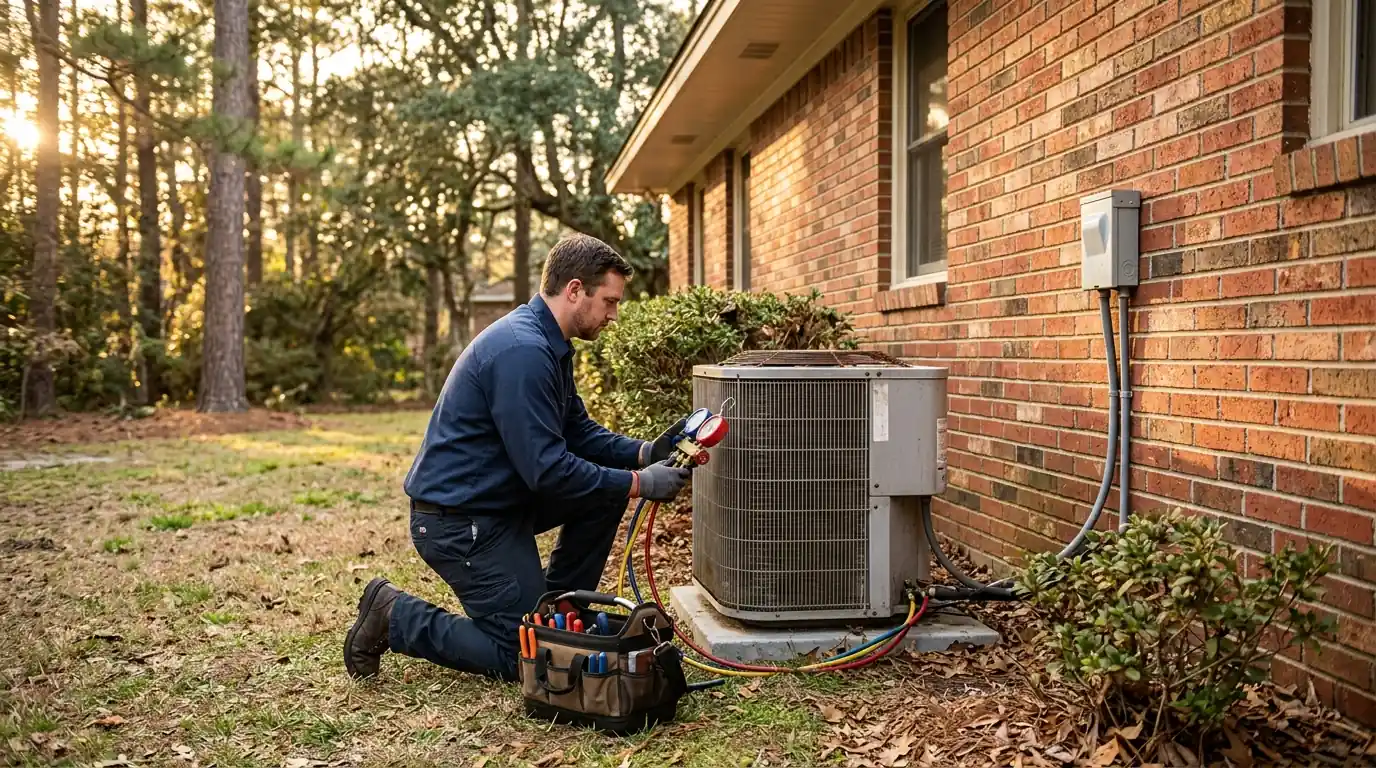
PTAC repair in Atlanta covers the packaged through-wall units in hotel rooms and apartments, which fail most often from clogged coils, failed fan motors, bad controls or water leaks from a blocked sleeve drain. When a unit is not worth repairing, a replacement chassis must match the existing wall sleeve size and grille, or the sleeve has to change too.
PTAC Repair & Replacement: what we check and why it matters
A PTAC packs a compressor, both coils, fans and often an electric heat strip or heat pump into one chassis that slides into a metal sleeve through the exterior wall. Because the outdoor coil faces the street or parking lot and the indoor coil pulls room air with little filtration, both load with dust, lint and pollen quickly.
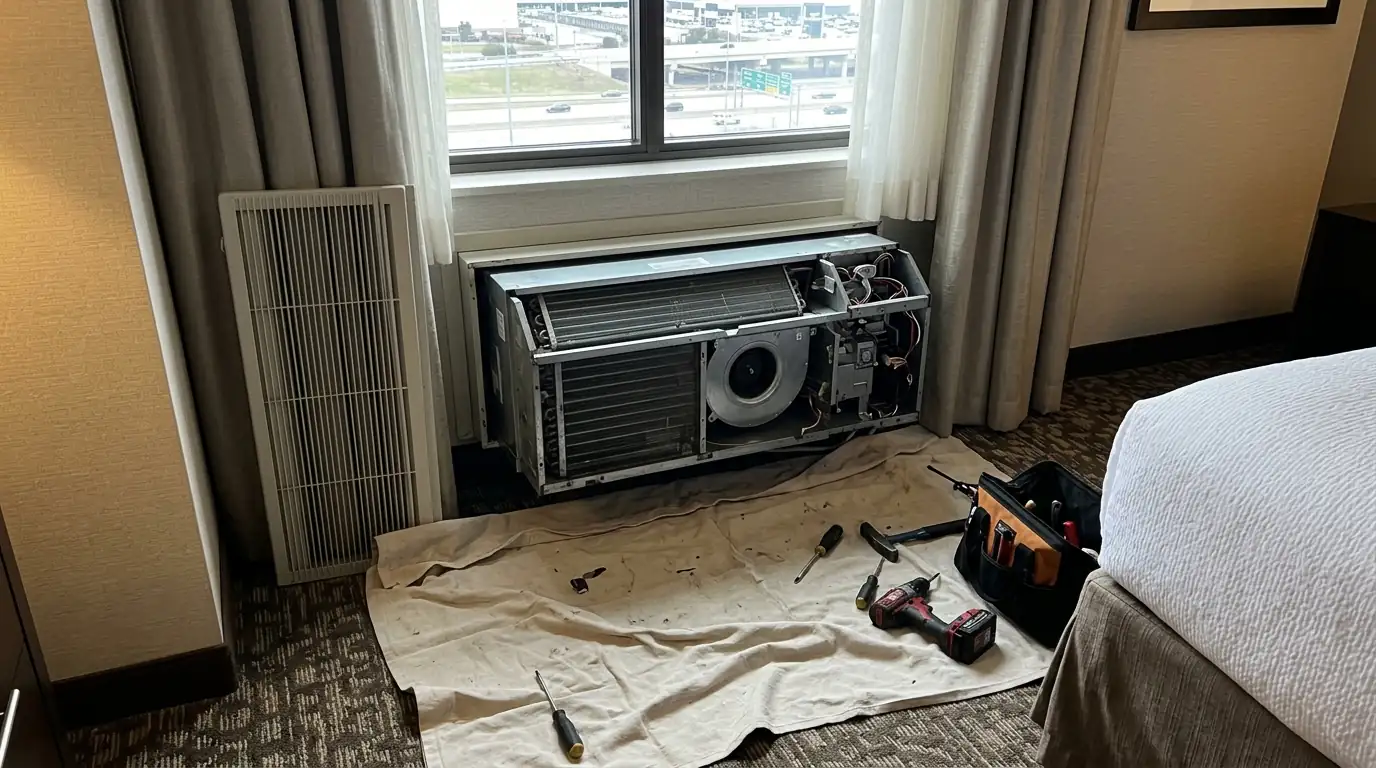
Most of our PTAC calls are coil and drain problems, fan motors, failed heat strips, and control boards or thermostats. We clean and test the chassis on a bench when we can and confirm the sleeve slopes outward so water drains to the outside. When a unit is beyond repair, we match a replacement chassis to the sleeve, voltage and grille so the wall does not need to be opened. Rooftop and split equipment on the same property falls under our commercial HVAC repair work.
Signs a PTAC needs service
Guests and tenants usually notice these first.
Water on the floor under the unit
Sleeve slope or a blocked drain opening is the usual cause.
Warm air on cooling mode
Dirty coils, a failed capacitor or a compressor problem.
Burning dust smell on heat
Lint on the heat strip, or a strip overheating.
Rattling or buzzing
Loose panels, an unbalanced fan wheel or a failing motor.
Musty room smell
Mold in the drain pan or on the indoor coil.
Tripped breaker or dead unit
A failed component drawing too much current, or a bad receptacle.
Hotel PTAC units
Hotels feel PTAC problems directly: a guest complains about a loud unit, a musty smell or a warm room, and the room goes out of service. Common causes are dirty indoor coils and filters, fan wheels out of balance, failed compressor capacitors and heat strips that will not energize on cold nights. We pull the chassis, clean coils and drain paths, test the controls, and swap failed parts. For properties with many units, we suggest keeping a spare chassis on hand so a failed unit can be swapped out right away and repaired off the floor without leaving the room out of service.
Apartment through-wall units
Apartments use PTACs and simpler through-wall units, sometimes as the only cooling and heat for the unit. Tenants notice water on the floor below the window, a unit that runs but barely cools, or heat that smells like burning dust. Water problems usually trace to a sleeve that has lost its outward slope or a blocked drain opening at the exterior grille. Cooling complaints often come from coils packed with lint and pet hair. We fix the immediate failure and tell the property manager whether that unit or others in the building show the same wear.
Sleeve and grille sizing
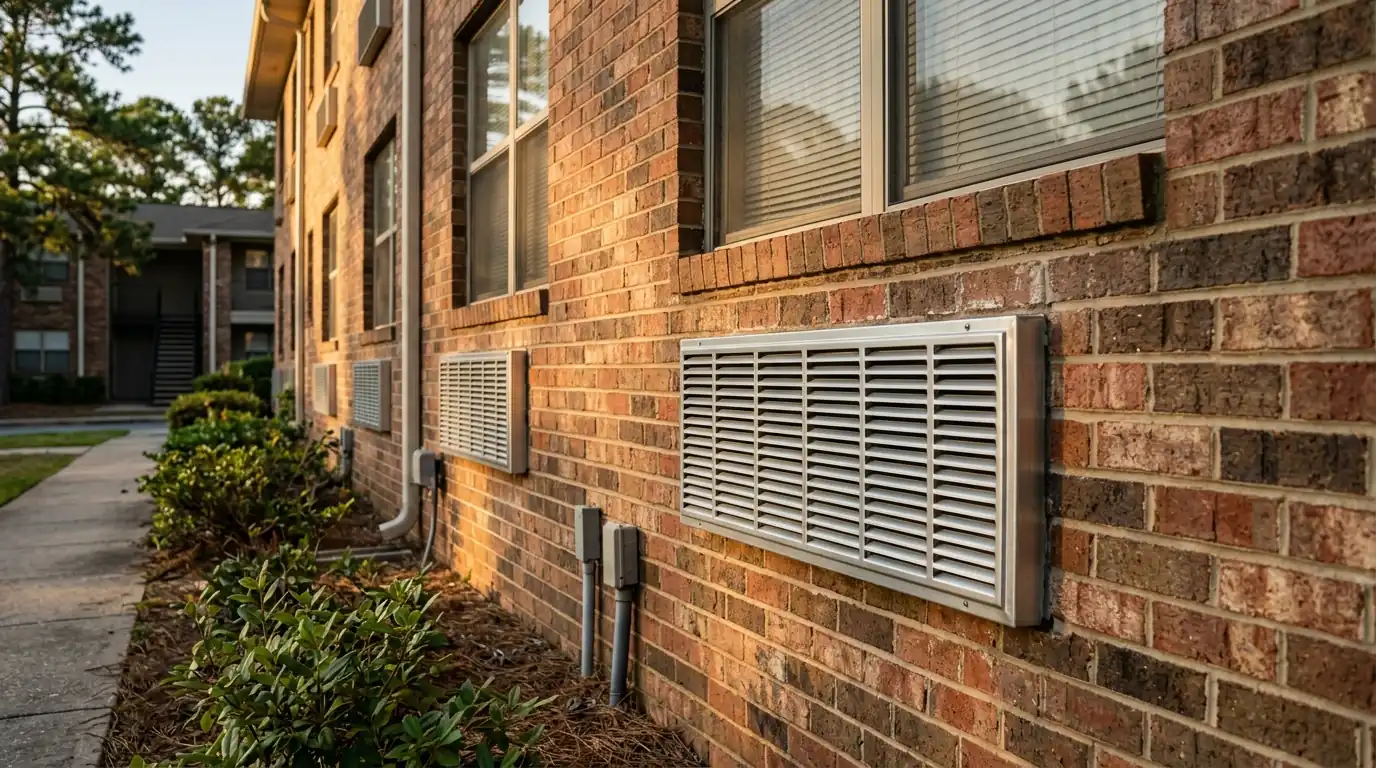
The wall sleeve sets what fits. Many PTACs use a standard sleeve close to 42 inches wide, but older and specialty units use different sizes, and grilles vary from stamped to architectural. When replacing a chassis, we measure the sleeve, check its condition and slope, confirm voltage and amperage at the receptacle, and match the grille. A rusted or out-of-square sleeve should be replaced at the same time, since a new chassis in a damaged sleeve leaks air and water. Where a sleeve does not match any current chassis, we look at adapter kits before cutting the wall.
How we handle a failed PTAC
Check power and controls
We confirm voltage at the receptacle and test the controls before pulling the chassis.
Pull and inspect
We slide the chassis out, check coils, fan wheels, motors and the drain path, and look at the sleeve condition.
Clean or repair
We clean coils and drain channels and replace failed motors, capacitors, heat strips or boards.
Check sleeve slope
We confirm the sleeve pitches slightly outward and the exterior drain opening is clear.
Reinstall and test
We seat the chassis, seal the room-side gasket and run both cooling and heating modes.
Equipment brands we service and install
Most homes around Atlanta run equipment from a handful of major manufacturers. We diagnose, repair and replace Carrier, Trane, Lennox, Goodman, Rheem and Daikin systems, along with the other names below.
Brand names are shown to describe the equipment we work on. We are not claiming a dealer or factory relationship with any manufacturer.
Where this shows up around Atlanta
Through-wall units are common in properties that house travelers. Clayton, the county that holds most of Hartsfield-Jackson, the world's busiest airport by passengers, and the hotels and extended-stay properties that serve those travelers lean heavily on PTACs in every room. In that setting, a failed unit usually means a room out of service until the chassis is swapped. Keeping track of which chassis are aging, which sleeves have lost their slope and which models share parts helps a property handle failures one room at a time.
Repair the chassis or replace it?
We weigh the age of the unit, the part that failed and how many sister units are aging alongside it.
| Repair the chassis | Replace the chassis | |
|---|---|---|
| Makes sense when | Motor, capacitor, board or heat strip failed | Compressor failed or coils are corroded |
| Sleeve | Reused as is | Reused if it fits and is sound |
| Downtime | Usually short | Short if a matching chassis is on hand |
| Longer view | Good if the unit is still young | Plan by age across the property |
Planning range for a PTAC replacement
The published range below covers replacing one PTAC unit installed. It is a planning figure, not our pricing, and the source itself reports somewhat different numbers in places.
| Job | Published planning range | Source |
|---|---|---|
| PTAC unit replacement, per unit installed | $500 to $2,500 per PTAC unit installed | PTAC Unit Cost Guide: Price Ranges, Installation, and Savings 2026 - Pick Comfort |
What moves the number
- Cooling size and heat type
- Whether the sleeve and grille are reused
- Voltage and receptacle changes
- Number of units replaced at once
- Floor and access within the building
These are ranges published by the sources linked above, shown for planning. They are not a quote and not our price; the real number depends on what we find at your home.
PTAC Repair & Replacement questions from Atlanta homeowners
Usually the sleeve has lost its slight outward slope, or the drain opening at the exterior grille is clogged with debris. Water then backs up and runs out the room side. A dirty indoor coil can also overflow its pan.
Many fit a common standard sleeve size, but not all. We measure the sleeve and check the grille before ordering. Where a mismatch exists, adapter kits sometimes solve it without changing the sleeve.
Heat pump PTACs use less electricity on mild winter days and switch to the heat strip when it gets colder. Units with electric heat only are simpler but cost more to run. For properties with long heating hours, heat pump models usually pay back.
Filters monthly in busy properties, and coils at least once or twice a year depending on lint and pollen. Many properties fold this into a scheduled maintenance plan so rooms rotate through cleaning without guest complaints.
In some apartments, yes, especially when the goal is quieter and more efficient operation. It means closing or reusing the wall sleeve and running a line set. Our mini-split installation page explains the options.
Most run on 208/230 volts, and some smaller units on 115 volts, with a plug type matched to the amperage. A replacement has to match the receptacle and circuit, which we confirm before ordering. Mismatched plugs are a common reason a replacement stalls.
Updated October 2026